The cinematic portrayal of Malèna, in Giuseppe Tornatore’s 2000 film Malèna, serves as a profound allegory for the human condition, where beauty becomes both a divine gift and a crucible of existential isolation. Malèna, a woman of striking physical allure, navigates a Sicilian town steeped in patriarchal desire and judgment, her aura radiating a spiritual…
The line—“My shine’s a guillotine, black diamonds gleam, / Time’s a corpse, no medics for the dream. / Custom death, I call the jeweller first, / Then the coroner—your fate’s been cursed. / My watch ticks doom, no mercy, no pause, / Your reflection kneels to my unholy laws”—is a haunting exploration of power, mortality,…
The philosophical underpinning of this vivid, violent poetic imagery lies in the tension between purity and corruption, a recurring theme in existential and moral philosophy. The speaker’s “barbaric antics” and katana-wielding poetry reflect a Nietzschean rejection of conventional morality, embracing a radical, destructive act to “cleanse” a world deemed inherently impure. This aligns with Nietzsche’s…
Hedonism, as articulated by thinkers like Epicurus or modern utilitarian’s, prioritizes pleasure as the ultimate good, often encouraging the pursuit of immediate sensory gratification. In the poem, hook-up and porn culture embody this philosophy, reducing sex to a “fleeting minute of plight” driven by “impulsive pleasures and desires.” This relentless chase for instant gratification is…
The poem Vultures depict the hook-up and porn culture as reducing sex to a “fleeting minute of plight” resonates deeply with both philosophical and biblical critiques of objectification and alienation. Philosophically, this aligns with existentialist perspectives, such as those of Jean-Paul Sartre and Martin Buber, who argue that objectification—treating others as mere objects for gratification—alienates…
Here is the refined version of your text with grammar corrections:
Loyalty and honesty are the most important qualities I look for in friendships and relationships with women. Without loyalty and honesty, relationships will eventually crumble like the 9/11 buildings.
The cinematic portrayal of Malèna, in Giuseppe Tornatore’s 2000 film Malèna, serves as a profound allegory for the human condition, where beauty becomes both a divine gift and a crucible of existential isolation. Malèna, a woman of striking physical allure, navigates a Sicilian town steeped in patriarchal desire and judgment, her aura radiating a spiritual…
The line—“My shine’s a guillotine, black diamonds gleam, / Time’s a corpse, no medics for the dream. / Custom death, I call the jeweller first, / Then the coroner—your fate’s been cursed. / My watch ticks doom, no mercy, no pause, / Your reflection kneels to my unholy laws”—is a haunting exploration of power, mortality,…
The philosophical underpinning of this vivid, violent poetic imagery lies in the tension between purity and corruption, a recurring theme in existential and moral philosophy. The speaker’s “barbaric antics” and katana-wielding poetry reflect a Nietzschean rejection of conventional morality, embracing a radical, destructive act to “cleanse” a world deemed inherently impure. This aligns with Nietzsche’s…
Hedonism, as articulated by thinkers like Epicurus or modern utilitarian’s, prioritizes pleasure as the ultimate good, often encouraging the pursuit of immediate sensory gratification. In the poem, hook-up and porn culture embody this philosophy, reducing sex to a “fleeting minute of plight” driven by “impulsive pleasures and desires.” This relentless chase for instant gratification is…
The poem Vultures depict the hook-up and porn culture as reducing sex to a “fleeting minute of plight” resonates deeply with both philosophical and biblical critiques of objectification and alienation. Philosophically, this aligns with existentialist perspectives, such as those of Jean-Paul Sartre and Martin Buber, who argue that objectification—treating others as mere objects for gratification—alienates…
don’t believe in religion because many teach that by your own might and power, you shall attain a heavenly spot. This is far from the truth because, without being perfect, your chance of getting to heaven is nearly impossible.
Christianity is unique in that it provides access to God through our mediator, Jesus Christ of Nazareth. Jesus lived a perfect life, took on the sin of the world, and defeated death by dying on the cross. This allows us to have a relationship with the Father through Jesus without the need for religious rituals or doing good works to earn a place in heaven.
The cinematic portrayal of Malèna, in Giuseppe Tornatore’s 2000 film Malèna, serves as a profound allegory for the human condition, where beauty becomes both a divine gift and a crucible of existential isolation. Malèna, a woman of striking physical allure, navigates a Sicilian town steeped in patriarchal desire and judgment, her aura radiating a spiritual…
The line—“My shine’s a guillotine, black diamonds gleam, / Time’s a corpse, no medics for the dream. / Custom death, I call the jeweller first, / Then the coroner—your fate’s been cursed. / My watch ticks doom, no mercy, no pause, / Your reflection kneels to my unholy laws”—is a haunting exploration of power, mortality,…
The philosophical underpinning of this vivid, violent poetic imagery lies in the tension between purity and corruption, a recurring theme in existential and moral philosophy. The speaker’s “barbaric antics” and katana-wielding poetry reflect a Nietzschean rejection of conventional morality, embracing a radical, destructive act to “cleanse” a world deemed inherently impure. This aligns with Nietzsche’s…
Hedonism, as articulated by thinkers like Epicurus or modern utilitarian’s, prioritizes pleasure as the ultimate good, often encouraging the pursuit of immediate sensory gratification. In the poem, hook-up and porn culture embody this philosophy, reducing sex to a “fleeting minute of plight” driven by “impulsive pleasures and desires.” This relentless chase for instant gratification is…
The poem Vultures depict the hook-up and porn culture as reducing sex to a “fleeting minute of plight” resonates deeply with both philosophical and biblical critiques of objectification and alienation. Philosophically, this aligns with existentialist perspectives, such as those of Jean-Paul Sartre and Martin Buber, who argue that objectification—treating others as mere objects for gratification—alienates…
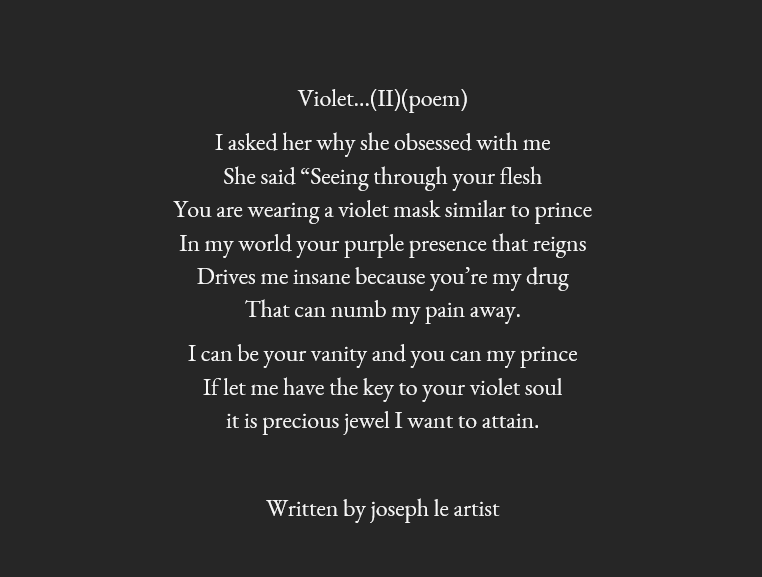
This poem captures an intense, almost obsessive affection from a woman towards the speaker. She explains her obsession by revealing that she perceives him as wearing a “violet mask,” likening him to Prince, whose iconic presence is both captivating and enigmatic. In her world, his “purple presence” reigns supreme, making him irresistible to her. She views him as a “drug” that alleviates her pain, offering solace. Her desire to be his “vanity” and for him to be her “prince” underscores her longing for a deep, reciprocal connection. She covets the “key to his violet soul,” which she considers a “precious jewel,” emphasizing her yearning to understand and possess his innermost being.
The poem is rich in imagery and metaphor, illustrating the profound impact the speaker has on the woman and her yearning for a closer bond with him.
The cinematic portrayal of Malèna, in Giuseppe Tornatore’s 2000 film Malèna, serves as a profound allegory for the human condition, where beauty becomes both a divine gift and a crucible of existential isolation. Malèna, a woman of striking physical allure, navigates a Sicilian town steeped in patriarchal desire and judgment, her aura radiating a spiritual…
The line—“My shine’s a guillotine, black diamonds gleam, / Time’s a corpse, no medics for the dream. / Custom death, I call the jeweller first, / Then the coroner—your fate’s been cursed. / My watch ticks doom, no mercy, no pause, / Your reflection kneels to my unholy laws”—is a haunting exploration of power, mortality,…
The philosophical underpinning of this vivid, violent poetic imagery lies in the tension between purity and corruption, a recurring theme in existential and moral philosophy. The speaker’s “barbaric antics” and katana-wielding poetry reflect a Nietzschean rejection of conventional morality, embracing a radical, destructive act to “cleanse” a world deemed inherently impure. This aligns with Nietzsche’s…
Hedonism, as articulated by thinkers like Epicurus or modern utilitarian’s, prioritizes pleasure as the ultimate good, often encouraging the pursuit of immediate sensory gratification. In the poem, hook-up and porn culture embody this philosophy, reducing sex to a “fleeting minute of plight” driven by “impulsive pleasures and desires.” This relentless chase for instant gratification is…
The poem Vultures depict the hook-up and porn culture as reducing sex to a “fleeting minute of plight” resonates deeply with both philosophical and biblical critiques of objectification and alienation. Philosophically, this aligns with existentialist perspectives, such as those of Jean-Paul Sartre and Martin Buber, who argue that objectification—treating others as mere objects for gratification—alienates…
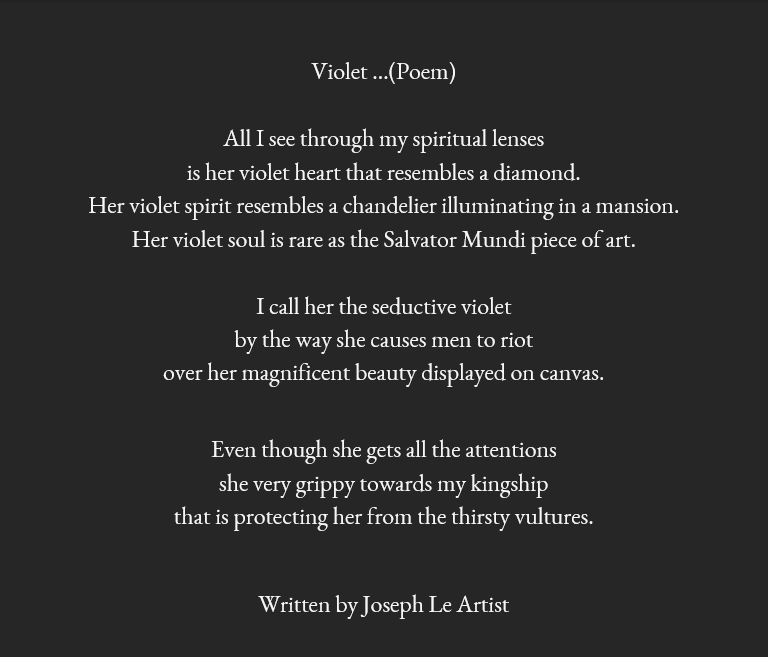
This poem delves into the speaker’s admiration and reverence for a woman whose beauty and spirit are depicted through rich, evocative imagery. The speaker views the woman through “spiritual lenses,” suggesting a deep, soulful connection and perception that goes beyond the physical.
The woman’s heart is described as “violet” and “resembles a diamond,” combining the rarity and preciousness of a diamond with the mystical, regal qualities of the color violet. This duality highlights her unique and invaluable nature. Her spirit, compared to a “chandelier illuminating in a mansion,” suggests a bright, radiant presence that lights up her surroundings with elegance and grace.
The comparison of her soul to the “Salvator Mundi piece of art” further emphasizes her rarity and exceptional value, likening her to one of the most famous and expensive artworks in the world. This metaphor underscores the idea that her essence is one-of-a-kind and highly treasured.
The speaker refers to her as the “seductive violet,” capturing the allure and magnetic charm she possesses, which causes men to “riot” over her beauty. This vivid imagery portrays her as a figure of great desire and admiration, whose presence on canvas (possibly metaphorical for her impact on the world) leaves a powerful impression.
Despite the attention she garners, she is described as “grippy towards my kingship,” indicating her loyalty and attachment to the speaker. The term “kingship” conveys a sense of protection and authority, suggesting that the speaker feels a duty to safeguard her from “thirsty vultures”—a metaphor for those who seek to exploit or harm her.
In summary, the poem paints a portrait of a woman whose beauty, spirit, and soul are portrayed with luxurious and rare imagery. It emphasizes her profound impact on those around her and her special connection with the speaker, who is devoted to protecting her from those who might not appreciate her true worth.
The cinematic portrayal of Malèna, in Giuseppe Tornatore’s 2000 film Malèna, serves as a profound allegory for the human condition, where beauty becomes both a divine gift and a crucible of existential isolation. Malèna, a woman of striking physical allure, navigates a Sicilian town steeped in patriarchal desire and judgment, her aura radiating a spiritual…
The line—“My shine’s a guillotine, black diamonds gleam, / Time’s a corpse, no medics for the dream. / Custom death, I call the jeweller first, / Then the coroner—your fate’s been cursed. / My watch ticks doom, no mercy, no pause, / Your reflection kneels to my unholy laws”—is a haunting exploration of power, mortality,…
The philosophical underpinning of this vivid, violent poetic imagery lies in the tension between purity and corruption, a recurring theme in existential and moral philosophy. The speaker’s “barbaric antics” and katana-wielding poetry reflect a Nietzschean rejection of conventional morality, embracing a radical, destructive act to “cleanse” a world deemed inherently impure. This aligns with Nietzsche’s…
Hedonism, as articulated by thinkers like Epicurus or modern utilitarian’s, prioritizes pleasure as the ultimate good, often encouraging the pursuit of immediate sensory gratification. In the poem, hook-up and porn culture embody this philosophy, reducing sex to a “fleeting minute of plight” driven by “impulsive pleasures and desires.” This relentless chase for instant gratification is…
The poem Vultures depict the hook-up and porn culture as reducing sex to a “fleeting minute of plight” resonates deeply with both philosophical and biblical critiques of objectification and alienation. Philosophically, this aligns with existentialist perspectives, such as those of Jean-Paul Sartre and Martin Buber, who argue that objectification—treating others as mere objects for gratification—alienates…
This poem explores the relationship between talent and the pursuit of artistic excellence, emphasizing that talent alone is insufficient for achieving greatness. The narrator begins by recognizing that merely possessing talent does not guarantee the ability to create enduring, impactful art (“Talent isn’t never enough when you trying to make the artistry infinitely blush with my paint brush”). The metaphor of making artistry “blush” suggests a desire to evoke deep emotion and beauty through one’s work.
The “artistry in human form” serves as a personified muse, offering wisdom to the artist. It acknowledges the artist’s ambition but reminds them of the limitations imposed by time (“you can’t infinitely make me blush your limited within time”). The muse asserts its own infinite nature, contrasting the temporal constraints of human life with the boundless essence of true art (“I am infinite and beyond this life”).
The imagery of a “golden brush in the hand of the divine” elevates the concept of art to a sacred level, suggesting that the ultimate form of artistry is a divine act, beyond human reach. This underscores the notion that human efforts, while valuable, are inherently limited.
The poem concludes with the muse advising the artist that talent must be complemented by other qualities: “time, perseverance, and consistency.” These elements are essential to maintain and refine even a small part of true artistry (“Will help you keep a small fragment of me sharp and refined”). The message is clear: artistic mastery requires ongoing dedication and hard work, not just innate ability.
In summary, the poem beautifully conveys the idea that while talent is a crucial starting point, it is the combination of persistent effort and commitment over time that allows an artist to truly capture and sustain the essence of their craft.













 LifeandTimelessart