The cinematic portrayal of Malèna, in Giuseppe Tornatore’s 2000 film Malèna, serves as a profound allegory for the human condition, where beauty becomes both a divine gift and a crucible of existential isolation. Malèna, a woman of striking physical allure, navigates a Sicilian town steeped in patriarchal desire and judgment, her aura radiating a spiritual…
The line—“My shine’s a guillotine, black diamonds gleam, / Time’s a corpse, no medics for the dream. / Custom death, I call the jeweller first, / Then the coroner—your fate’s been cursed. / My watch ticks doom, no mercy, no pause, / Your reflection kneels to my unholy laws”—is a haunting exploration of power, mortality,…
The philosophical underpinning of this vivid, violent poetic imagery lies in the tension between purity and corruption, a recurring theme in existential and moral philosophy. The speaker’s “barbaric antics” and katana-wielding poetry reflect a Nietzschean rejection of conventional morality, embracing a radical, destructive act to “cleanse” a world deemed inherently impure. This aligns with Nietzsche’s…
Hedonism, as articulated by thinkers like Epicurus or modern utilitarian’s, prioritizes pleasure as the ultimate good, often encouraging the pursuit of immediate sensory gratification. In the poem, hook-up and porn culture embody this philosophy, reducing sex to a “fleeting minute of plight” driven by “impulsive pleasures and desires.” This relentless chase for instant gratification is…
The poem Vultures depict the hook-up and porn culture as reducing sex to a “fleeting minute of plight” resonates deeply with both philosophical and biblical critiques of objectification and alienation. Philosophically, this aligns with existentialist perspectives, such as those of Jean-Paul Sartre and Martin Buber, who argue that objectification—treating others as mere objects for gratification—alienates…
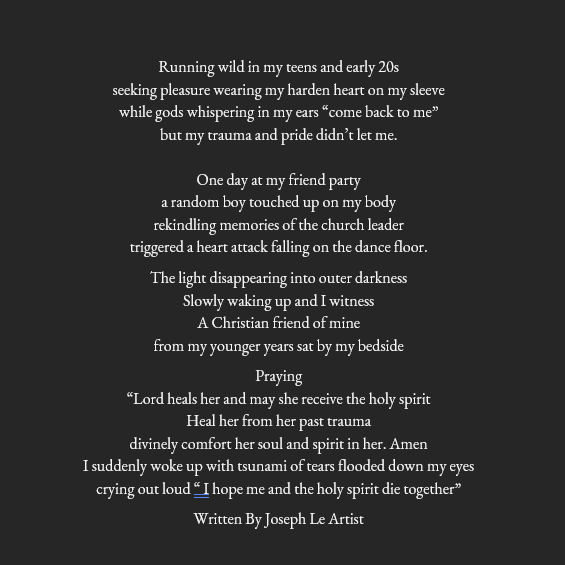
From a young age, she longed to walk with God in His golden garden, dreaming of divine peace and eternal connection. But her innocence was shattered when a trusted church leader betrayed her, masking his lust as piety and leaving her to grapple with emotions she couldn’t understand. Seeking comfort from her parents, she found only disbelief, their reverence for the leader outweighing her cries for help.
The betrayal hardened her heart, and she turned away from faith, embracing rebellion in her teens and twenties. Though God’s whispers beckoned her back, pride and trauma kept her distant. A moment of unwanted touch at a party rekindled buried memories, triggering a physical and emotional collapse.
As she drifted between light and darkness, an old Christian friend prayed at her side, pleading for healing and divine comfort. Awakening to their prayer, she wept, overwhelmed by the weight of her pain and a fragile hope for redemption. In her tears, she cried out, longing for an unbreakable connection with the Holy Spirit, even if it meant leaving this life behind.
The cinematic portrayal of Malèna, in Giuseppe Tornatore’s 2000 film Malèna, serves as a profound allegory for the human condition, where beauty becomes both a divine gift and a crucible of existential isolation. Malèna, a woman of striking physical allure, navigates a Sicilian town steeped in patriarchal desire and judgment, her aura radiating a spiritual…
The line—“My shine’s a guillotine, black diamonds gleam, / Time’s a corpse, no medics for the dream. / Custom death, I call the jeweller first, / Then the coroner—your fate’s been cursed. / My watch ticks doom, no mercy, no pause, / Your reflection kneels to my unholy laws”—is a haunting exploration of power, mortality,…
The philosophical underpinning of this vivid, violent poetic imagery lies in the tension between purity and corruption, a recurring theme in existential and moral philosophy. The speaker’s “barbaric antics” and katana-wielding poetry reflect a Nietzschean rejection of conventional morality, embracing a radical, destructive act to “cleanse” a world deemed inherently impure. This aligns with Nietzsche’s…
Hedonism, as articulated by thinkers like Epicurus or modern utilitarian’s, prioritizes pleasure as the ultimate good, often encouraging the pursuit of immediate sensory gratification. In the poem, hook-up and porn culture embody this philosophy, reducing sex to a “fleeting minute of plight” driven by “impulsive pleasures and desires.” This relentless chase for instant gratification is…
The poem Vultures depict the hook-up and porn culture as reducing sex to a “fleeting minute of plight” resonates deeply with both philosophical and biblical critiques of objectification and alienation. Philosophically, this aligns with existentialist perspectives, such as those of Jean-Paul Sartre and Martin Buber, who argue that objectification—treating others as mere objects for gratification—alienates…
The summer season is my favourite season. The sun’s rays illuminate the brightest throughout the day, and the sky is a crystal clear blue. Butterflies and bees extract nectar as they rest on red roses in the gardens. The sun beaming makes everything in nature comes alive in variety of vibrant colours. The gentle unseen breeze hitting your skin as you ride your bicycle through the city or the countryside is refreshing. Children laughing and playing with water guns in the park, teenagers playing soccer/football nearby in the park. the smell of the smell of food coming from the barbeque.
Beautiful women sunbathing in the sunshine while their beauty are displayed like art pieces in art museums as you walk through the beach. The summer atmosphere is filled with joy and vibrancy, making summer a season of warmth, life, and endless possibilities. Whether it’s a picnic in the park, a stroll on the beach, or simply enjoying an ice cream cone under the blazing sun, every moment is filled with a sense of carefree happiness and radiant energy.
The cinematic portrayal of Malèna, in Giuseppe Tornatore’s 2000 film Malèna, serves as a profound allegory for the human condition, where beauty becomes both a divine gift and a crucible of existential isolation. Malèna, a woman of striking physical allure, navigates a Sicilian town steeped in patriarchal desire and judgment, her aura radiating a spiritual…
The line—“My shine’s a guillotine, black diamonds gleam, / Time’s a corpse, no medics for the dream. / Custom death, I call the jeweller first, / Then the coroner—your fate’s been cursed. / My watch ticks doom, no mercy, no pause, / Your reflection kneels to my unholy laws”—is a haunting exploration of power, mortality,…
The philosophical underpinning of this vivid, violent poetic imagery lies in the tension between purity and corruption, a recurring theme in existential and moral philosophy. The speaker’s “barbaric antics” and katana-wielding poetry reflect a Nietzschean rejection of conventional morality, embracing a radical, destructive act to “cleanse” a world deemed inherently impure. This aligns with Nietzsche’s…
Hedonism, as articulated by thinkers like Epicurus or modern utilitarian’s, prioritizes pleasure as the ultimate good, often encouraging the pursuit of immediate sensory gratification. In the poem, hook-up and porn culture embody this philosophy, reducing sex to a “fleeting minute of plight” driven by “impulsive pleasures and desires.” This relentless chase for instant gratification is…
The poem Vultures depict the hook-up and porn culture as reducing sex to a “fleeting minute of plight” resonates deeply with both philosophical and biblical critiques of objectification and alienation. Philosophically, this aligns with existentialist perspectives, such as those of Jean-Paul Sartre and Martin Buber, who argue that objectification—treating others as mere objects for gratification—alienates…
So far this year, I have spent most of my time speaking to God and creating art by writing poems to escape this current reality. I do have friends, but as I grow older, my circle of friends becomes smaller. Most of my time these days is spent increasing my knowledge and expanding my world , faith and artistry. I know the next chapter in my life will be better, filled with excellence and potency. Until then, I am putting in the work for a better future, putting God first.
The cinematic portrayal of Malèna, in Giuseppe Tornatore’s 2000 film Malèna, serves as a profound allegory for the human condition, where beauty becomes both a divine gift and a crucible of existential isolation. Malèna, a woman of striking physical allure, navigates a Sicilian town steeped in patriarchal desire and judgment, her aura radiating a spiritual…
The line—“My shine’s a guillotine, black diamonds gleam, / Time’s a corpse, no medics for the dream. / Custom death, I call the jeweller first, / Then the coroner—your fate’s been cursed. / My watch ticks doom, no mercy, no pause, / Your reflection kneels to my unholy laws”—is a haunting exploration of power, mortality,…
The philosophical underpinning of this vivid, violent poetic imagery lies in the tension between purity and corruption, a recurring theme in existential and moral philosophy. The speaker’s “barbaric antics” and katana-wielding poetry reflect a Nietzschean rejection of conventional morality, embracing a radical, destructive act to “cleanse” a world deemed inherently impure. This aligns with Nietzsche’s…
Hedonism, as articulated by thinkers like Epicurus or modern utilitarian’s, prioritizes pleasure as the ultimate good, often encouraging the pursuit of immediate sensory gratification. In the poem, hook-up and porn culture embody this philosophy, reducing sex to a “fleeting minute of plight” driven by “impulsive pleasures and desires.” This relentless chase for instant gratification is…
The poem Vultures depict the hook-up and porn culture as reducing sex to a “fleeting minute of plight” resonates deeply with both philosophical and biblical critiques of objectification and alienation. Philosophically, this aligns with existentialist perspectives, such as those of Jean-Paul Sartre and Martin Buber, who argue that objectification—treating others as mere objects for gratification—alienates…
This book taught me about the financial economy and how money truly works in circulation. Robert Kiyosaki explains how his poor dad taught him to earn money the traditional way (go to school, college, university, graduate, and find work—money comes in). His rich dad taught him to understand money, meaning to find a vehicle such as a business where money works for you instead of working for money the traditional way.
Here are five key takeaways from “Rich Dad Poor Dad” by Robert Kiyosaki:
The Importance of Financial Education:
Financial literacy is crucial. Schools often do not teach financial education, which leads to a lack of understanding about managing money, investments, and wealth-building strategies. Kiyosaki stresses the importance of learning about finances to make informed decisions.
The Difference Between Assets and Liabilities:
Understanding the distinction between assets and liabilities is fundamental. Assets bring in money, while liabilities take money out of your pocket. Kiyosaki advises focusing on acquiring assets, such as real estate, stocks, and businesses, that generate income.
The Concept of Working for Money vs. Money Working for You:
Instead of working for money, strive to have money work for you. This involves investing in income-generating assets and creating passive income streams. The goal is to reach a point where your investments provide enough income to cover your expenses.
The Power of Entrepreneurship and Investing:
Entrepreneurship and investing are key pathways to financial independence. Kiyosaki encourages people to consider starting their own businesses and making smart investments. This approach provides more control over your financial future compared to relying solely on a traditional job.
Overcoming Fear and Taking Risks:
Taking calculated risks and overcoming the fear of failure are essential for financial success. Kiyosaki emphasizes that many people miss out on opportunities because they are afraid to take risks. Learning from failures and persisting through challenges is crucial for building wealth.
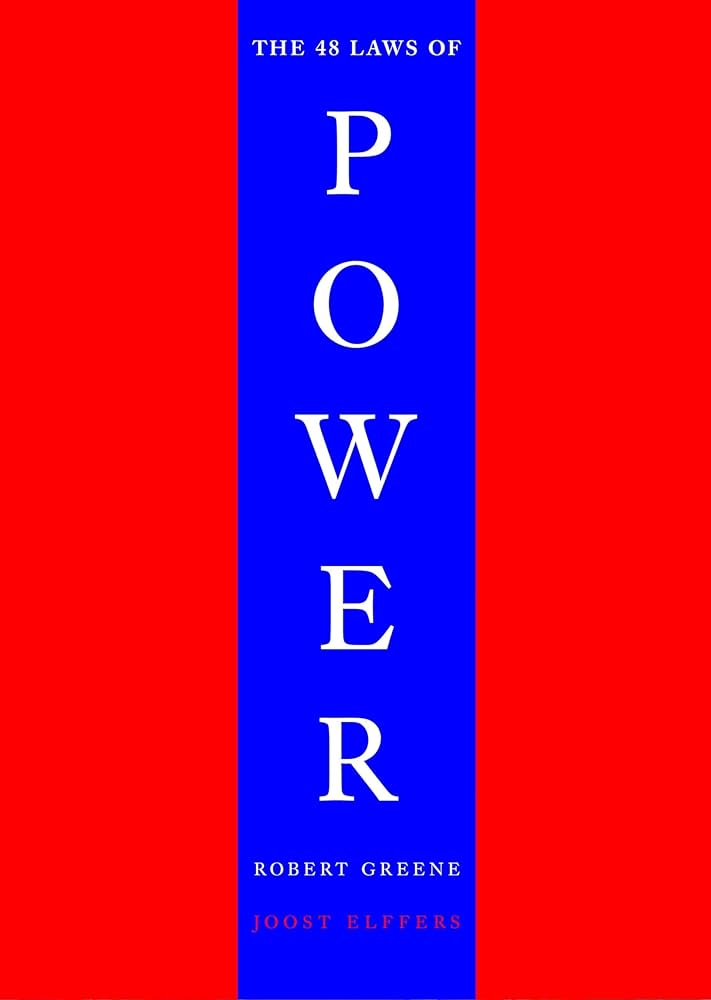
48 laws Of Power
“Reading the 48 Laws of Power helped me understand and identify a narcissist in the room. Understanding the nature of a narcissist will help an individual navigate through life using the knowledge of each narcissistic quality and principle in the book.”
Here are five key takeaways from “The 48 Laws of Power” by Robert Greene:
Law 1: Never Outshine the Master:
Always make those above you feel superior. It is dangerous to outshine your superiors as it can generate envy and resentment. Instead, make them feel more capable and competent, and you will gain their favor.
Law 6: Court Attention at All Costs:
Stand out and make yourself known. All attention, whether good or bad, is beneficial. If you are not noticed, you will fade into obscurity. By attracting attention, you enhance your presence and influence.
Law 15: Crush Your Enemy Totally:
Leave no room for your enemies to recover and retaliate. By eliminating them completely, you ensure that they cannot come back to challenge or harm you. Total victory prevents future threats and solidifies your power.
Law 33: Discover Each Man’s Thumbscrew:
Find and exploit the weaknesses of others. Everyone has a vulnerability, whether it is an insecurity, a need, or a secret. By understanding and manipulating these weaknesses, you can influence and control people more effectively.
Law 48: Assume Formlessness:
Be adaptable and fluid in your strategies and tactics. Rigidity can be your downfall. By being formless, you remain unpredictable and elusive, making it difficult for others to understand or counteract your plans. Flexibility allows you to adjust to changing circumstances and seize opportunities.
Book of Daniel from the Bible.
Observing and understanding Daniel’s journey to the top of the Babylonian empire is very inspirational. Daniel never sacrificed his beliefs, principles, and character to appease or fit in with the culture. Daniel’s opposition to Babylonian culture catapulted him and his two friends to the top positions of political power in Babylon.
My lesson from Daniel’s life is that you can’t be physically and spiritually successful without going against the norms and mediocrity of society.
Here are five key success takeaways from the Book of Daniel:
Faithfulness and Integrity:
Daniel remained steadfast in his faith and principles, refusing to compromise even when pressured. His unwavering integrity earned him respect and favor, demonstrating that staying true to one’s values is crucial for long-term success.
Courage in Adversity:
Daniel and his friends faced significant threats, including being thrown into the lion’s den and the fiery furnace. Their courage in the face of adversity showed that true success often requires bravery and the willingness to stand up for one’s beliefs, even under extreme pressure.
Wisdom and Knowledge:
Daniel was known for his exceptional wisdom and understanding. He diligently sought knowledge and divine insight, which enabled him to interpret dreams and solve complex problems. This illustrates the importance of continuous learning and seeking wisdom to navigate challenges effectively.
Adaptability and Resilience:
Despite being taken captive and living in a foreign land with different customs, Daniel adapted without losing his identity. His resilience in the face of changing circumstances highlights the importance of being adaptable while maintaining core values.
Seeking Divine Guidance:
Daniel consistently sought guidance through prayer and reliance on God. This spiritual discipline provided him with the clarity and strength needed to make wise decisions. This takeaway underscores the importance of seeking higher guidance and maintaining a strong spiritual practice in achieving success.
The cinematic portrayal of Malèna, in Giuseppe Tornatore’s 2000 film Malèna, serves as a profound allegory for the human condition, where beauty becomes both a divine gift and a crucible of existential isolation. Malèna, a woman of striking physical allure, navigates a Sicilian town steeped in patriarchal desire and judgment, her aura radiating a spiritual…
The line—“My shine’s a guillotine, black diamonds gleam, / Time’s a corpse, no medics for the dream. / Custom death, I call the jeweller first, / Then the coroner—your fate’s been cursed. / My watch ticks doom, no mercy, no pause, / Your reflection kneels to my unholy laws”—is a haunting exploration of power, mortality,…
The philosophical underpinning of this vivid, violent poetic imagery lies in the tension between purity and corruption, a recurring theme in existential and moral philosophy. The speaker’s “barbaric antics” and katana-wielding poetry reflect a Nietzschean rejection of conventional morality, embracing a radical, destructive act to “cleanse” a world deemed inherently impure. This aligns with Nietzsche’s…
Hedonism, as articulated by thinkers like Epicurus or modern utilitarian’s, prioritizes pleasure as the ultimate good, often encouraging the pursuit of immediate sensory gratification. In the poem, hook-up and porn culture embody this philosophy, reducing sex to a “fleeting minute of plight” driven by “impulsive pleasures and desires.” This relentless chase for instant gratification is…
The poem Vultures depict the hook-up and porn culture as reducing sex to a “fleeting minute of plight” resonates deeply with both philosophical and biblical critiques of objectification and alienation. Philosophically, this aligns with existentialist perspectives, such as those of Jean-Paul Sartre and Martin Buber, who argue that objectification—treating others as mere objects for gratification—alienates…
This poem explores the deceptive nature of lust, contrasting its initial allure with its eventual destructiveness. It begins with an idealized perception of lust, likening it to a beautiful, innocent woman whose gaze captivates the narrator. This initial portrayal emphasizes the superficial charm and attractiveness of lust.
However, the poem takes a darker turn as it delves deeper into the true nature of lust. The imagery shifts dramatically, revealing lust as a malevolent force akin to Ms. Trunchbull, a character known for her cruelty, armed with deadly weapons. This personification highlights the lurking danger and potential for harm that lust carries.
The poem continues to depict lust’s destructive power, illustrating it as a voracious entity that feeds on its victims’ blood, causing chaos and devastation. The final lines evoke a sense of impending doom, drawing a parallel to the historical figure Joan of Arc, who was burned at the stake. This reference underscores the severity of lust’s consequences, portraying it as a force that can lead to one’s downfall and suffering.
Overall, the poem serves as a cautionary tale, warning against the seductive yet perilous nature of lust, and urging readers to recognize and guard against its destructive potential.
Sure, here are seven philosophical takeaways from your poem:
Illusion vs. Reality: The poem begins with a beautiful, idealized vision of lust, but later reveals a more sinister reality. This highlights the philosophical theme that appearances can be deceptive, and understanding the true nature of something requires looking beyond surface impressions.
The Nature of Desire: Lust is initially portrayed as alluring and captivating, symbolizing the powerful draw of desire. However, its destructive potential suggests that unchecked desire can lead to ruin, a concept explored by many philosophers, including the Stoics, who advocate for self-control and moderation.
Duality of Human Experience: The poem contrasts beauty and danger, innocence and malevolence, reflecting the dual nature of many human experiences. This duality suggests that positive and negative aspects often coexist, a theme seen in Taoist philosophy with the concept of yin and yang.
The Consequences of Indulgence: By depicting lust as ultimately harmful, the poem aligns with philosophical teachings on the dangers of indulgence and excess. Philosophers like Aristotle advocate for the “golden mean,” where virtue lies in moderation between extremes.
The Role of Perception: The poem’s shift from enchantment to horror underscores the importance of perception in shaping our understanding of the world. Philosophers such as Kant have explored how our perceptions influence our reality, suggesting that what we see is filtered through our mental frameworks.
Moral and Ethical Reflection: The transformation of lust from an innocent beauty to a dangerous force prompts a moral and ethical reflection on the nature of our desires and actions. It encourages a deeper consideration of the ethical implications of succumbing to base instincts.
The Power of Metaphor: Using metaphors like Ms. Trunchbull and Joan of Arc, the poem conveys complex ideas about lust and its effects. This illustrates the philosophical idea that metaphors and stories can powerfully shape our understanding of abstract concepts, as argued by thinkers like Lakoff and Johnson in their work on conceptual metaphor theory.
These takeaways offer a rich tapestry of philosophical reflections prompted by the poem’s exploration of lust and its consequences.
















 LifeandTimelessart