The philosophical underpinning of this vivid, violent poetic imagery lies in the tension between purity and corruption, a recurring theme in existential and moral philosophy. The speaker’s “barbaric antics” and katana-wielding poetry reflect a Nietzschean rejection of conventional morality, embracing a radical, destructive act to “cleanse” a world deemed inherently impure. This aligns with Nietzsche’s…
Hedonism, as articulated by thinkers like Epicurus or modern utilitarian’s, prioritizes pleasure as the ultimate good, often encouraging the pursuit of immediate sensory gratification. In the poem, hook-up and porn culture embody this philosophy, reducing sex to a “fleeting minute of plight” driven by “impulsive pleasures and desires.” This relentless chase for instant gratification is…
The poem Vultures depict the hook-up and porn culture as reducing sex to a “fleeting minute of plight” resonates deeply with both philosophical and biblical critiques of objectification and alienation. Philosophically, this aligns with existentialist perspectives, such as those of Jean-Paul Sartre and Martin Buber, who argue that objectification—treating others as mere objects for gratification—alienates…
The concept of “broken soul ties” in the poem resonates with Martin Buber’s I-Thou philosophy, which champions authentic, mutual relationships where individuals encounter each other as sacred subjects. When soul ties break, it signals a collapse of this I-Thou dynamic, reducing others to mere objects (I-It), fostering isolation and distrust. This erosion of trust, as…
From an existentialist perspective, the “perfect cycle of lust” encapsulates humanity’s entanglement with inauthentic desires, a concept deeply explored by philosopher Jean-Paul Sartre. Lust, as depicted in the poem, emerges as a repetitive and ultimately hollow pursuit that diverts individuals from a meaningful existence. Rather than fostering genuine connection or love, it ensnares the speaker…
I’m constantly inspired by Daniel 1:20, where one man’s wisdom shone ten times brighter than his peers, as I strive to grow 10x better every single day. This isn’t just about sharpening my skills or building mental resilience—it’s about carving my own path to personal growth and self-discovery. Is it wrong, as Sade might sing,…
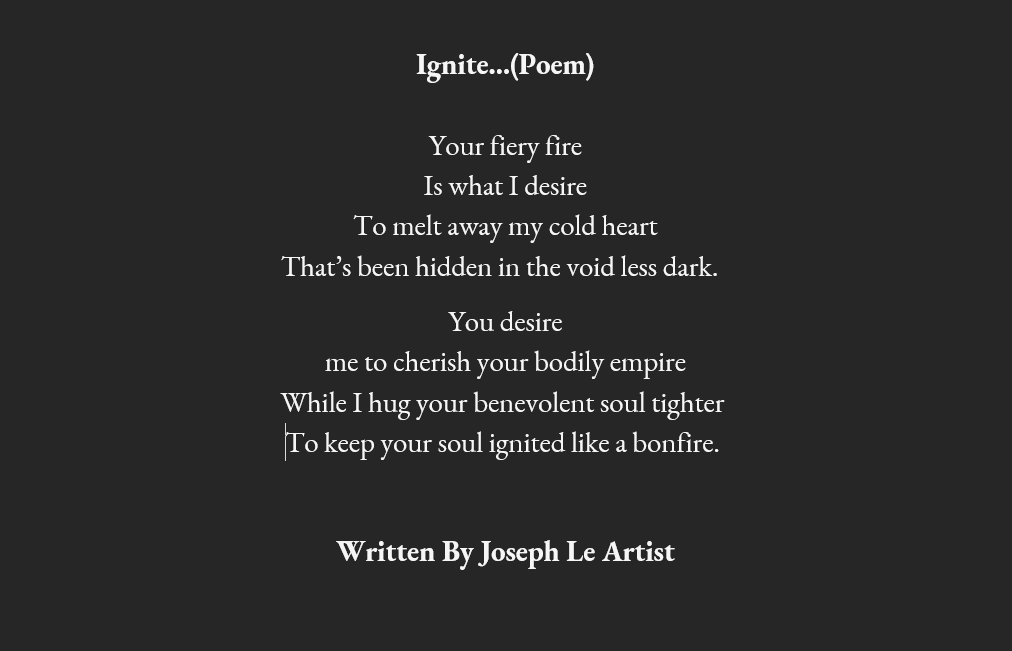
I find myself drawn to this blazing force within me—my “fiery fire”—a restless, burning energy that I crave to awaken fully. It’s as if I’m seeking to dissolve the frost encasing my heart, a coldness I’ve carried too long, tucked away in a place I call the “void less dark.” That phrase feels right to me—a shadow not pitch-black, but muted, a half-lit emptiness where I’ve lingered, neither lost nor found. Philosophers like Heraclitus might see this fire as my life’s constant flux, a heat that promises to reshape me if I let it.
But there’s a tension I can’t ignore. This fire I tend, this soul I ignite—it’s fleeting. A bonfire roars only as long as I feed it, and my cold heart, my void, they hover close, ready to reclaim me. I wonder if this is what Sartre meant by crafting meaning in the face of nothing—a refusal to let the dark win. Or maybe it’s Nietzsche’s voice I hear, urging me to embrace this cycle of melting and burning, to affirm myself again and again. I’m caught in that dance, desiring my own renewal, holding my soul’s light steady against the shadows I know too well.
The philosophical underpinning of this vivid, violent poetic imagery lies in the tension between purity and corruption, a recurring theme in existential and moral philosophy. The speaker’s “barbaric antics” and katana-wielding poetry reflect a Nietzschean rejection of conventional morality, embracing a radical, destructive act to “cleanse” a world deemed inherently impure. This aligns with Nietzsche’s…
Hedonism, as articulated by thinkers like Epicurus or modern utilitarian’s, prioritizes pleasure as the ultimate good, often encouraging the pursuit of immediate sensory gratification. In the poem, hook-up and porn culture embody this philosophy, reducing sex to a “fleeting minute of plight” driven by “impulsive pleasures and desires.” This relentless chase for instant gratification is…
The poem Vultures depict the hook-up and porn culture as reducing sex to a “fleeting minute of plight” resonates deeply with both philosophical and biblical critiques of objectification and alienation. Philosophically, this aligns with existentialist perspectives, such as those of Jean-Paul Sartre and Martin Buber, who argue that objectification—treating others as mere objects for gratification—alienates…
The concept of “broken soul ties” in the poem resonates with Martin Buber’s I-Thou philosophy, which champions authentic, mutual relationships where individuals encounter each other as sacred subjects. When soul ties break, it signals a collapse of this I-Thou dynamic, reducing others to mere objects (I-It), fostering isolation and distrust. This erosion of trust, as…
From an existentialist perspective, the “perfect cycle of lust” encapsulates humanity’s entanglement with inauthentic desires, a concept deeply explored by philosopher Jean-Paul Sartre. Lust, as depicted in the poem, emerges as a repetitive and ultimately hollow pursuit that diverts individuals from a meaningful existence. Rather than fostering genuine connection or love, it ensnares the speaker…
I’m constantly inspired by Daniel 1:20, where one man’s wisdom shone ten times brighter than his peers, as I strive to grow 10x better every single day. This isn’t just about sharpening my skills or building mental resilience—it’s about carving my own path to personal growth and self-discovery. Is it wrong, as Sade might sing,…
The Sixth Tread from “Call Me A.C Green..(Poem): “Virginity as a Gift: Building Integrity for My Future Wife”
“One DM from a girl resembling Vanity… My sex drive is packaged as a gift for my future wifey.” That’s the line I walk—a fleeting temptation in my inbox, a spark that could ignite my sex drive, yet a choice to hold it back. Virginity isn’t just a status for me; it’s a gift, something I’m shaping with every “no” I say to the now, saving it for my future wife. A message pops up, her words dripping with allure like Vanity, the singer whose beauty once captivated the world. But I scroll past, not because I’m immune, but because integrity matters more. Kant’s principle whispers in my ear, and scripture seals it: “Husbands, love your wives, just as Christ loved the church” (Ephesians 5:25). My virginity is a promise, a piece of me I’m building for her.
Temptation’s Knock
Temptation doesn’t come with a warning label—it slips in quietly, like that DM lighting up my phone. She’s not just a name; she’s a mirror of Vanity—stunning, magnetic, a test of my resolve. My sex drive kicks in, a natural pulse I can’t deny. I could reply, let the conversation flow, see where it leads. No one would know. But I stop myself. Not out of fear, but out of something deeper—a principle I’ve chosen to live by. That moment isn’t just about resisting; it’s about building, stacking another brick of integrity for the man I want to be.
Vanity’s allure fades when I think of what’s ahead. Temptation promises a thrill, but it’s fleeting—a sugar rush that leaves me empty. My sex drive isn’t the enemy; it’s a force I’m channeling, a gift I’m wrapping up for someone I haven’t met yet. One swipe, one reply, could unravel that, but I’d rather hold it together for her.
Integrity Over Impulse
Integrity isn’t loud—it’s steady, a quiet strength that grows every time I choose the long game over the short one. Kant, the philosopher, talked about the categorical imperative: act in a way you’d want to be universal, a rule for everyone. For me, that’s what virginity becomes—a principle, not just a personal quirk. I’m not saving it because it’s easy; I’m saving it because it’s right, because I’d want my future wife to trust me with her whole self too. It’s a standard I set for myself, a way of living that says my word, my body, my soul—they all mean something.
This isn’t about shutting down my sex drive—it’s about giving it purpose. That DM might stir it up, but integrity keeps it in check. I’m not perfect; some days, the temptation feels like a tug-of-war. But every time I walk away, I’m stronger, more the man I want her to find when the time comes.
Scripture’s Blueprint
Scripture gives me the why behind the what. Ephesians 5:25 isn’t just a verse—it’s a vision: “Husbands, love your wives, just as Christ loved the church and gave himself up for her.” That’s the kind of love I’m preparing for—sacrificial, selfless, all-in. My virginity isn’t a badge of pride; it’s a piece of that giving, a way I’m starting now to love her like Christ loved. It’s not about rules—it’s about relationship, about showing up for her with something pure and whole.
Then there’s Proverbs 4:23: “Keep your heart with all vigilance, for from it flow the springs of life.” My heart’s where this battle plays out—where temptation meets integrity, where my sex drive meets my faith. Guarding it isn’t passive; it’s active, a choice to protect what flows from it. That DM could crack the door open, but Proverbs tells me to lock it tight—not out of paranoia, but out of care for what I’m building.
A Gift Worth Waiting For
Virginity as a gift isn’t a cliché to me—it’s real. It’s not just about my body; it’s about my character, my commitment, the way I’m shaping myself for my future wife. That girl like Vanity? She’s a shadow, a flicker of now. My future wife is the flame I’m saving this for—a love I haven’t seen yet but believe in enough to wait for. My sex drive isn’t wasted; it’s packaged, tied with the ribbon of integrity, ready for the day it’s hers.
This gift isn’t about denying myself—it’s about defining myself. Every temptation I turn from is a step toward her, a piece of trust I’m earning before we even meet. Kant’s principle keeps me honest; scripture keeps me hopeful. Together, they turn my virginity into something active, not passive—a choice I make for love.
The Man I’ll Be
So I let that DM sit unanswered, not because I’m better than anyone, but because I’m building something bigger. My future wife deserves a man who’s wrestled with temptation and won, not by luck, but by principle. My sex drive is hers, a gift I’m keeping safe with every “no” I say today. Vanity can’t sway me—not when integrity’s my compass and faith’s my guide.
On life’s court, I’m still A.C. Green—sharp, steadfast, unashamed. My virginity isn’t a burden; it’s a promise, a piece of me I’m crafting for her, day by day.










 LifeandTimelessart