IntroAlex O’Connor Hypocrisy On Animal Suffering is a thought-provoking philosophical essay (likely from a debate or analysis channel) that challenges the common atheist argument against God’s existence based on animal suffering. It argues that such critiques can be hypocritical, as they often ignore humanity’s own massive role in causing and perpetuating animal pain through factory…
Intro Before I crossed the threshold into that pulsing underworld, I handed my soul to a fallen angel at the door—sealing a Faustian bargain for women who existed only in virtual promise, illusions spun from desire and digital haze. Inside, the club drowned in dark misty buzz, hypnotic music clamping my mind like a vice…
Intro In the shadowed attic of old grief, I found those frantic, handwritten letters—blasphemies scratched out by a younger me during a season of unrelenting calamity, heart emptied by pain and the lack of any real help. One page, opened on a whim, carried the desperate lie: “cursing God will fill your pocket with freedom…
Intro Sometimes I think about why the urge to create feels so natural, almost unavoidable, as if it was placed inside us long before we understood what art even was. It makes me wonder if creativity is part of the reason we exist at all—like God invented us so imagination could move through human hands…
Intro In an age where virtue is performed beneath studio lights and righteousness is rehearsed for applause, the loudest saviors often cast the longest shadows. History has shown how public personas can crumble — from the fall of R. Kelly to the scandal surrounding Jeffrey Epstein — revealing how influence and power can conceal disturbing…
IntroThis poem presents a sharp and cautionary portrait of a woman whose outer beauty conceals inner danger. By comparing her appearance to Stacy Dash, the speaker immediately establishes an image of striking physical attractiveness, only to contrast it with the darker image of a “fallen angel.” Throughout the poem, religious symbolism—halos, horns, heaven—blends with modern…
IntroPurpose and destiny have always guided me, embodied in figures like Tia and Tamara, whose presence kept me steady and focused on achieving higher victories. Their influence lit a path toward growth and fulfillment, shaping my choices and ambitions. Yet, life’s temptations came in the form of vices resembling Samara, pulling me toward darker paths…
IntroThrough powerful biblical symbolism and vivid, confrontational imagery, the poem examines the complex tension between femininity, masculinity, and authority. By invoking Moses parting the Red Sea as a metaphor for spiritual revelation and division, the speaker establishes a dramatic tone that carries throughout the piece. The contrasting portrayals of “quiet and feminine grace” against loud,…
IntroThrough powerful biblical symbolism and vivid, confrontational imagery, the poem examines the complex tension between femininity, masculinity, and authority. By invoking Moses parting the Red Sea as a metaphor for spiritual revelation and division, the speaker establishes a dramatic tone that carries throughout the piece. The contrasting portrayals of “quiet and feminine grace” against loud,…
Intro“King Solomon Size” evokes the legendary magnitude of love and desire associated with Solomon, using his grand reputation as a metaphor for vast romantic ambition. The poem speaks in the voice of a man who longs to warm his “cold and dark” heart through touch, admiration, and conquest, revealing both vulnerability and hunger for devotion.…
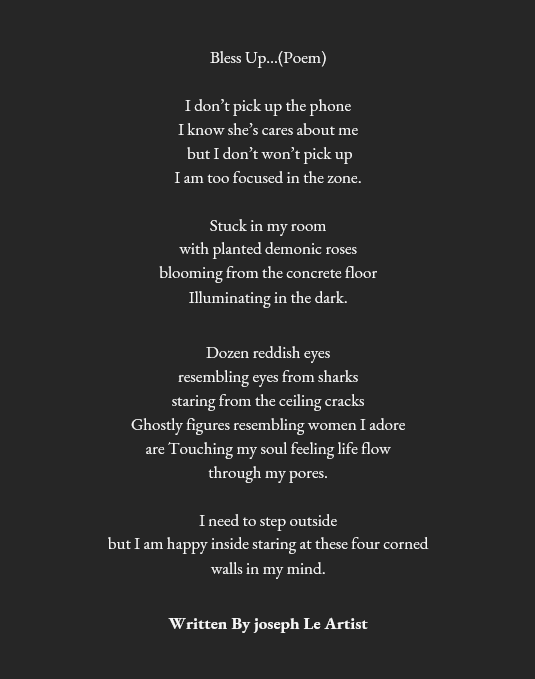
This poem captures a moment of introspection and emotional conflict, portraying the poet’s inner turmoil and sense of isolation. The poet is deeply absorbed in their own thoughts and struggles, reflected in their refusal to answer a caring call, choosing instead to remain “in the zone.”
The setting is stark and evocative: the poet is confined to their room, which is depicted with a surreal, almost nightmarish quality. The “planted demonic roses blooming from the concrete floor” suggest a sense of beauty intertwined with darkness, illuminating the room in an unsettling way.
The imagery of “dozen reddish eyes resembling eyes from sharks staring from the ceiling cracks” adds to the eerie atmosphere, indicating a sense of being watched or judged by sinister forces. These ghostly figures, resembling women the poet adores, add a layer of emotional complexity, as they touch the poet’s soul and evoke a sense of life flowing through them.
Despite this haunting environment, the poet feels a paradoxical comfort in their isolation. They recognize the need to step outside but find a peculiar happiness within the confines of their room, staring at the “four-cornered walls” in their mind.
The poem explores themes of isolation, introspection, and the conflict between the desire for connection and the comfort of solitude. The vivid, haunting imagery effectively conveys the poet’s internal struggle and the complex emotions associated with their state of mind.
IntroAlex O’Connor Hypocrisy On Animal Suffering is a thought-provoking philosophical essay (likely from a debate or analysis channel) that challenges the common atheist argument against God’s existence based on animal suffering. It argues that such critiques can be hypocritical, as they often ignore humanity’s own massive role in causing and perpetuating animal pain through factory…
Intro Before I crossed the threshold into that pulsing underworld, I handed my soul to a fallen angel at the door—sealing a Faustian bargain for women who existed only in virtual promise, illusions spun from desire and digital haze. Inside, the club drowned in dark misty buzz, hypnotic music clamping my mind like a vice…
Intro In the shadowed attic of old grief, I found those frantic, handwritten letters—blasphemies scratched out by a younger me during a season of unrelenting calamity, heart emptied by pain and the lack of any real help. One page, opened on a whim, carried the desperate lie: “cursing God will fill your pocket with freedom…
Intro Sometimes I think about why the urge to create feels so natural, almost unavoidable, as if it was placed inside us long before we understood what art even was. It makes me wonder if creativity is part of the reason we exist at all—like God invented us so imagination could move through human hands…
Intro In an age where virtue is performed beneath studio lights and righteousness is rehearsed for applause, the loudest saviors often cast the longest shadows. History has shown how public personas can crumble — from the fall of R. Kelly to the scandal surrounding Jeffrey Epstein — revealing how influence and power can conceal disturbing…
IntroThis poem presents a sharp and cautionary portrait of a woman whose outer beauty conceals inner danger. By comparing her appearance to Stacy Dash, the speaker immediately establishes an image of striking physical attractiveness, only to contrast it with the darker image of a “fallen angel.” Throughout the poem, religious symbolism—halos, horns, heaven—blends with modern…
IntroPurpose and destiny have always guided me, embodied in figures like Tia and Tamara, whose presence kept me steady and focused on achieving higher victories. Their influence lit a path toward growth and fulfillment, shaping my choices and ambitions. Yet, life’s temptations came in the form of vices resembling Samara, pulling me toward darker paths…
IntroThrough powerful biblical symbolism and vivid, confrontational imagery, the poem examines the complex tension between femininity, masculinity, and authority. By invoking Moses parting the Red Sea as a metaphor for spiritual revelation and division, the speaker establishes a dramatic tone that carries throughout the piece. The contrasting portrayals of “quiet and feminine grace” against loud,…
IntroThrough powerful biblical symbolism and vivid, confrontational imagery, the poem examines the complex tension between femininity, masculinity, and authority. By invoking Moses parting the Red Sea as a metaphor for spiritual revelation and division, the speaker establishes a dramatic tone that carries throughout the piece. The contrasting portrayals of “quiet and feminine grace” against loud,…
Intro“King Solomon Size” evokes the legendary magnitude of love and desire associated with Solomon, using his grand reputation as a metaphor for vast romantic ambition. The poem speaks in the voice of a man who longs to warm his “cold and dark” heart through touch, admiration, and conquest, revealing both vulnerability and hunger for devotion.…
This poem reflects on profound thoughts and spiritual musings while the poet partakes in a simple, mundane activity—eating a slice of pizza. The juxtaposition of the ordinary with the extraordinary serves to emphasize the depth of the poet’s contemplation.
The poem begins by introducing the concept of an “unseen Perfection,” a divine or transcendent force that creates perfection in human form. This perfect human once ruled the world with power and grace, symbolizing an ideal state of existence.
However, the poem takes a turn as it describes the fall from grace. The human, who once embodied perfection, becomes corrupted and debased due to breaking the perfect laws that were established. This fall leads to a loss of the divine radiance that once shone upon the human’s face, symbolizing a departure from purity and enlightenment.
The “unseen Perfection” then decides to intervene, aiming to salvage and restore the flawed human back to their original state of perfection. This act of restoration is depicted as a redemptive process, where the divine seeks to reinstate the human to a position of rightful dominion, ruling once again with perfect justice and grace.
The poem encapsulates themes of creation, fall, and redemption, highlighting a cyclical journey from perfection to imperfection and back to perfection. It underscores the idea of a higher power’s intent to restore balance and harmony in the world, reflecting on the possibility of reclaiming lost purity and grace through divine intervention.
IntroAlex O’Connor Hypocrisy On Animal Suffering is a thought-provoking philosophical essay (likely from a debate or analysis channel) that challenges the common atheist argument against God’s existence based on animal suffering. It argues that such critiques can be hypocritical, as they often ignore humanity’s own massive role in causing and perpetuating animal pain through factory…
Intro Before I crossed the threshold into that pulsing underworld, I handed my soul to a fallen angel at the door—sealing a Faustian bargain for women who existed only in virtual promise, illusions spun from desire and digital haze. Inside, the club drowned in dark misty buzz, hypnotic music clamping my mind like a vice…
Intro In the shadowed attic of old grief, I found those frantic, handwritten letters—blasphemies scratched out by a younger me during a season of unrelenting calamity, heart emptied by pain and the lack of any real help. One page, opened on a whim, carried the desperate lie: “cursing God will fill your pocket with freedom…
Intro Sometimes I think about why the urge to create feels so natural, almost unavoidable, as if it was placed inside us long before we understood what art even was. It makes me wonder if creativity is part of the reason we exist at all—like God invented us so imagination could move through human hands…
Intro In an age where virtue is performed beneath studio lights and righteousness is rehearsed for applause, the loudest saviors often cast the longest shadows. History has shown how public personas can crumble — from the fall of R. Kelly to the scandal surrounding Jeffrey Epstein — revealing how influence and power can conceal disturbing…
IntroThis poem presents a sharp and cautionary portrait of a woman whose outer beauty conceals inner danger. By comparing her appearance to Stacy Dash, the speaker immediately establishes an image of striking physical attractiveness, only to contrast it with the darker image of a “fallen angel.” Throughout the poem, religious symbolism—halos, horns, heaven—blends with modern…
IntroPurpose and destiny have always guided me, embodied in figures like Tia and Tamara, whose presence kept me steady and focused on achieving higher victories. Their influence lit a path toward growth and fulfillment, shaping my choices and ambitions. Yet, life’s temptations came in the form of vices resembling Samara, pulling me toward darker paths…
IntroThrough powerful biblical symbolism and vivid, confrontational imagery, the poem examines the complex tension between femininity, masculinity, and authority. By invoking Moses parting the Red Sea as a metaphor for spiritual revelation and division, the speaker establishes a dramatic tone that carries throughout the piece. The contrasting portrayals of “quiet and feminine grace” against loud,…
IntroThrough powerful biblical symbolism and vivid, confrontational imagery, the poem examines the complex tension between femininity, masculinity, and authority. By invoking Moses parting the Red Sea as a metaphor for spiritual revelation and division, the speaker establishes a dramatic tone that carries throughout the piece. The contrasting portrayals of “quiet and feminine grace” against loud,…
Intro“King Solomon Size” evokes the legendary magnitude of love and desire associated with Solomon, using his grand reputation as a metaphor for vast romantic ambition. The poem speaks in the voice of a man who longs to warm his “cold and dark” heart through touch, admiration, and conquest, revealing both vulnerability and hunger for devotion.…
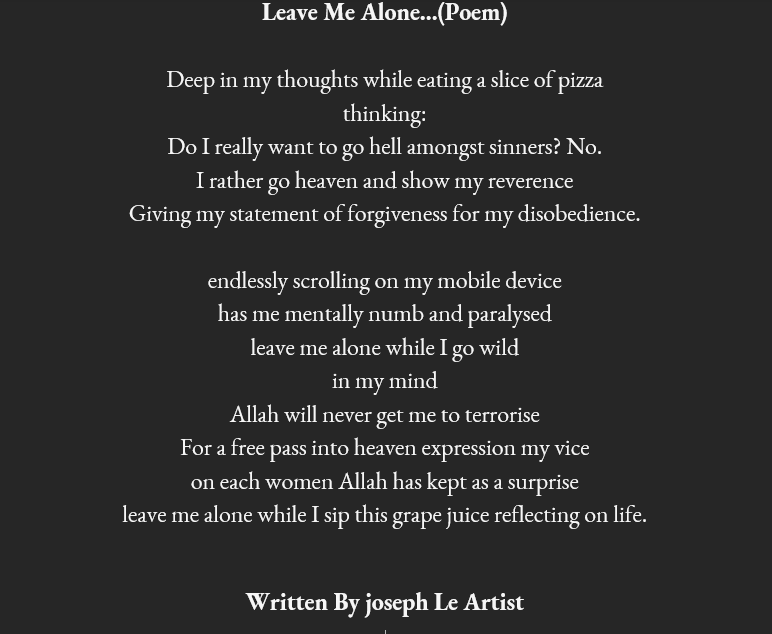
This poem offers a contemplative glimpse into the poet’s mind as they engage in everyday activities. The poem begins with the poet reflecting deeply while eating a slice of pizza, contemplating their spiritual fate. They reject the idea of going to hell and express a preference for going to heaven, demonstrating reverence and seeking forgiveness for past disobedience.
The poem then shifts to a modern scene of scrolling on a mobile device, which leaves the poet feeling mentally numb and paralyzed. This contrast between spiritual contemplation and digital distraction highlights the poet’s struggle to balance the two.
In the midst of this mental chaos, the poet reaffirms their faith, declaring that their devotion to Allah will never lead them to commit acts of terror in the name of religion. They speak of women in heaven as a divine surprise, indicating their respect for the spiritual rewards promised by their faith.
The poem concludes with the poet seeking solitude, sipping grape juice and reflecting on life. This final image ties together the themes of contemplation, spirituality, and the search for personal peace amid the distractions of modern life.
IntroAlex O’Connor Hypocrisy On Animal Suffering is a thought-provoking philosophical essay (likely from a debate or analysis channel) that challenges the common atheist argument against God’s existence based on animal suffering. It argues that such critiques can be hypocritical, as they often ignore humanity’s own massive role in causing and perpetuating animal pain through factory…
Intro Before I crossed the threshold into that pulsing underworld, I handed my soul to a fallen angel at the door—sealing a Faustian bargain for women who existed only in virtual promise, illusions spun from desire and digital haze. Inside, the club drowned in dark misty buzz, hypnotic music clamping my mind like a vice…
Intro In the shadowed attic of old grief, I found those frantic, handwritten letters—blasphemies scratched out by a younger me during a season of unrelenting calamity, heart emptied by pain and the lack of any real help. One page, opened on a whim, carried the desperate lie: “cursing God will fill your pocket with freedom…
Intro Sometimes I think about why the urge to create feels so natural, almost unavoidable, as if it was placed inside us long before we understood what art even was. It makes me wonder if creativity is part of the reason we exist at all—like God invented us so imagination could move through human hands…
Intro In an age where virtue is performed beneath studio lights and righteousness is rehearsed for applause, the loudest saviors often cast the longest shadows. History has shown how public personas can crumble — from the fall of R. Kelly to the scandal surrounding Jeffrey Epstein — revealing how influence and power can conceal disturbing…
IntroThis poem presents a sharp and cautionary portrait of a woman whose outer beauty conceals inner danger. By comparing her appearance to Stacy Dash, the speaker immediately establishes an image of striking physical attractiveness, only to contrast it with the darker image of a “fallen angel.” Throughout the poem, religious symbolism—halos, horns, heaven—blends with modern…
IntroPurpose and destiny have always guided me, embodied in figures like Tia and Tamara, whose presence kept me steady and focused on achieving higher victories. Their influence lit a path toward growth and fulfillment, shaping my choices and ambitions. Yet, life’s temptations came in the form of vices resembling Samara, pulling me toward darker paths…
IntroThrough powerful biblical symbolism and vivid, confrontational imagery, the poem examines the complex tension between femininity, masculinity, and authority. By invoking Moses parting the Red Sea as a metaphor for spiritual revelation and division, the speaker establishes a dramatic tone that carries throughout the piece. The contrasting portrayals of “quiet and feminine grace” against loud,…
IntroThrough powerful biblical symbolism and vivid, confrontational imagery, the poem examines the complex tension between femininity, masculinity, and authority. By invoking Moses parting the Red Sea as a metaphor for spiritual revelation and division, the speaker establishes a dramatic tone that carries throughout the piece. The contrasting portrayals of “quiet and feminine grace” against loud,…
Intro“King Solomon Size” evokes the legendary magnitude of love and desire associated with Solomon, using his grand reputation as a metaphor for vast romantic ambition. The poem speaks in the voice of a man who longs to warm his “cold and dark” heart through touch, admiration, and conquest, revealing both vulnerability and hunger for devotion.…
This poem explores the deceptive nature of lust, contrasting its initial allure with its eventual destructiveness. It begins with an idealized perception of lust, likening it to a beautiful, innocent woman whose gaze captivates the narrator. This initial portrayal emphasizes the superficial charm and attractiveness of lust.
However, the poem takes a darker turn as it delves deeper into the true nature of lust. The imagery shifts dramatically, revealing lust as a malevolent force akin to Ms. Trunchbull, a character known for her cruelty, armed with deadly weapons. This personification highlights the lurking danger and potential for harm that lust carries.
The poem continues to depict lust’s destructive power, illustrating it as a voracious entity that feeds on its victims’ blood, causing chaos and devastation. The final lines evoke a sense of impending doom, drawing a parallel to the historical figure Joan of Arc, who was burned at the stake. This reference underscores the severity of lust’s consequences, portraying it as a force that can lead to one’s downfall and suffering.
Overall, the poem serves as a cautionary tale, warning against the seductive yet perilous nature of lust, and urging readers to recognize and guard against its destructive potential.
Sure, here are seven philosophical takeaways from your poem:
Illusion vs. Reality: The poem begins with a beautiful, idealized vision of lust, but later reveals a more sinister reality. This highlights the philosophical theme that appearances can be deceptive, and understanding the true nature of something requires looking beyond surface impressions.
The Nature of Desire: Lust is initially portrayed as alluring and captivating, symbolizing the powerful draw of desire. However, its destructive potential suggests that unchecked desire can lead to ruin, a concept explored by many philosophers, including the Stoics, who advocate for self-control and moderation.
Duality of Human Experience: The poem contrasts beauty and danger, innocence and malevolence, reflecting the dual nature of many human experiences. This duality suggests that positive and negative aspects often coexist, a theme seen in Taoist philosophy with the concept of yin and yang.
The Consequences of Indulgence: By depicting lust as ultimately harmful, the poem aligns with philosophical teachings on the dangers of indulgence and excess. Philosophers like Aristotle advocate for the “golden mean,” where virtue lies in moderation between extremes.
The Role of Perception: The poem’s shift from enchantment to horror underscores the importance of perception in shaping our understanding of the world. Philosophers such as Kant have explored how our perceptions influence our reality, suggesting that what we see is filtered through our mental frameworks.
Moral and Ethical Reflection: The transformation of lust from an innocent beauty to a dangerous force prompts a moral and ethical reflection on the nature of our desires and actions. It encourages a deeper consideration of the ethical implications of succumbing to base instincts.
The Power of Metaphor: Using metaphors like Ms. Trunchbull and Joan of Arc, the poem conveys complex ideas about lust and its effects. This illustrates the philosophical idea that metaphors and stories can powerfully shape our understanding of abstract concepts, as argued by thinkers like Lakoff and Johnson in their work on conceptual metaphor theory.
These takeaways offer a rich tapestry of philosophical reflections prompted by the poem’s exploration of lust and its consequences.
IntroAlex O’Connor Hypocrisy On Animal Suffering is a thought-provoking philosophical essay (likely from a debate or analysis channel) that challenges the common atheist argument against God’s existence based on animal suffering. It argues that such critiques can be hypocritical, as they often ignore humanity’s own massive role in causing and perpetuating animal pain through factory…
Intro Before I crossed the threshold into that pulsing underworld, I handed my soul to a fallen angel at the door—sealing a Faustian bargain for women who existed only in virtual promise, illusions spun from desire and digital haze. Inside, the club drowned in dark misty buzz, hypnotic music clamping my mind like a vice…
Intro In the shadowed attic of old grief, I found those frantic, handwritten letters—blasphemies scratched out by a younger me during a season of unrelenting calamity, heart emptied by pain and the lack of any real help. One page, opened on a whim, carried the desperate lie: “cursing God will fill your pocket with freedom…
Intro Sometimes I think about why the urge to create feels so natural, almost unavoidable, as if it was placed inside us long before we understood what art even was. It makes me wonder if creativity is part of the reason we exist at all—like God invented us so imagination could move through human hands…
Intro In an age where virtue is performed beneath studio lights and righteousness is rehearsed for applause, the loudest saviors often cast the longest shadows. History has shown how public personas can crumble — from the fall of R. Kelly to the scandal surrounding Jeffrey Epstein — revealing how influence and power can conceal disturbing…
IntroThis poem presents a sharp and cautionary portrait of a woman whose outer beauty conceals inner danger. By comparing her appearance to Stacy Dash, the speaker immediately establishes an image of striking physical attractiveness, only to contrast it with the darker image of a “fallen angel.” Throughout the poem, religious symbolism—halos, horns, heaven—blends with modern…
IntroPurpose and destiny have always guided me, embodied in figures like Tia and Tamara, whose presence kept me steady and focused on achieving higher victories. Their influence lit a path toward growth and fulfillment, shaping my choices and ambitions. Yet, life’s temptations came in the form of vices resembling Samara, pulling me toward darker paths…
IntroThrough powerful biblical symbolism and vivid, confrontational imagery, the poem examines the complex tension between femininity, masculinity, and authority. By invoking Moses parting the Red Sea as a metaphor for spiritual revelation and division, the speaker establishes a dramatic tone that carries throughout the piece. The contrasting portrayals of “quiet and feminine grace” against loud,…
IntroThrough powerful biblical symbolism and vivid, confrontational imagery, the poem examines the complex tension between femininity, masculinity, and authority. By invoking Moses parting the Red Sea as a metaphor for spiritual revelation and division, the speaker establishes a dramatic tone that carries throughout the piece. The contrasting portrayals of “quiet and feminine grace” against loud,…
Intro“King Solomon Size” evokes the legendary magnitude of love and desire associated with Solomon, using his grand reputation as a metaphor for vast romantic ambition. The poem speaks in the voice of a man who longs to warm his “cold and dark” heart through touch, admiration, and conquest, revealing both vulnerability and hunger for devotion.…
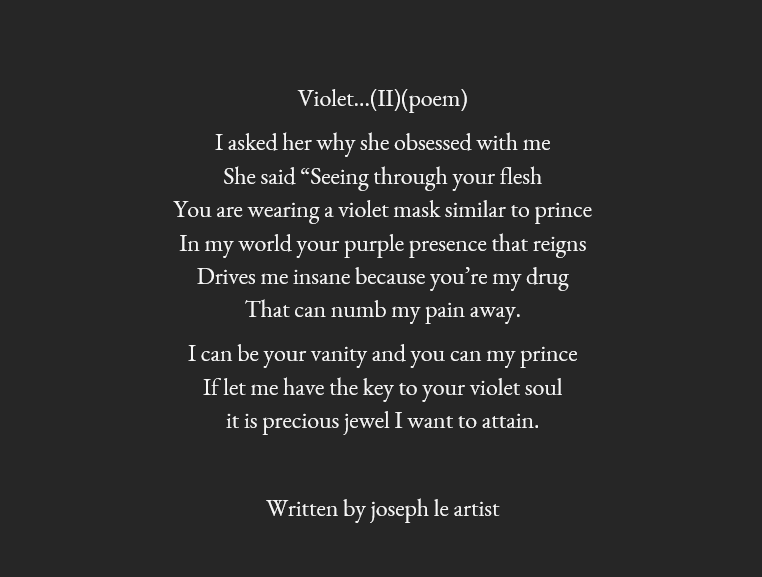
This poem captures an intense, almost obsessive affection from a woman towards the speaker. She explains her obsession by revealing that she perceives him as wearing a “violet mask,” likening him to Prince, whose iconic presence is both captivating and enigmatic. In her world, his “purple presence” reigns supreme, making him irresistible to her. She views him as a “drug” that alleviates her pain, offering solace. Her desire to be his “vanity” and for him to be her “prince” underscores her longing for a deep, reciprocal connection. She covets the “key to his violet soul,” which she considers a “precious jewel,” emphasizing her yearning to understand and possess his innermost being.
The poem is rich in imagery and metaphor, illustrating the profound impact the speaker has on the woman and her yearning for a closer bond with him.











 LifeandTimelessart