Dissected Threads
Tread One : Scorched Poem: Exploring Sin and Redemption Through Bible Themes and Passion…(Blog)
Thread Two : Scorched by The Penmanship And Sins (Dissect video) – LifeandTimelessart
IntroAlex O’Connor Hypocrisy On Animal Suffering is a thought-provoking philosophical essay (likely from a debate or analysis channel) that challenges the common atheist argument against God’s existence based on animal suffering. It argues that such critiques can be hypocritical, as they often ignore humanity’s own massive role in causing and perpetuating animal pain through factory…
Intro Before I crossed the threshold into that pulsing underworld, I handed my soul to a fallen angel at the door—sealing a Faustian bargain for women who existed only in virtual promise, illusions spun from desire and digital haze. Inside, the club drowned in dark misty buzz, hypnotic music clamping my mind like a vice…
Intro In the shadowed attic of old grief, I found those frantic, handwritten letters—blasphemies scratched out by a younger me during a season of unrelenting calamity, heart emptied by pain and the lack of any real help. One page, opened on a whim, carried the desperate lie: “cursing God will fill your pocket with freedom…
Intro Sometimes I think about why the urge to create feels so natural, almost unavoidable, as if it was placed inside us long before we understood what art even was. It makes me wonder if creativity is part of the reason we exist at all—like God invented us so imagination could move through human hands…
Intro In an age where virtue is performed beneath studio lights and righteousness is rehearsed for applause, the loudest saviors often cast the longest shadows. History has shown how public personas can crumble — from the fall of R. Kelly to the scandal surrounding Jeffrey Epstein — revealing how influence and power can conceal disturbing…

IntroThis poem presents a sharp and cautionary portrait of a woman whose outer beauty conceals inner danger. By comparing her appearance to Stacy Dash, the speaker immediately establishes an image of striking physical attractiveness, only to contrast it with the darker image of a “fallen angel.” Throughout the poem, religious symbolism—halos, horns, heaven—blends with modern…

IntroPurpose and destiny have always guided me, embodied in figures like Tia and Tamara, whose presence kept me steady and focused on achieving higher victories. Their influence lit a path toward growth and fulfillment, shaping my choices and ambitions. Yet, life’s temptations came in the form of vices resembling Samara, pulling me toward darker paths…
IntroThrough powerful biblical symbolism and vivid, confrontational imagery, the poem examines the complex tension between femininity, masculinity, and authority. By invoking Moses parting the Red Sea as a metaphor for spiritual revelation and division, the speaker establishes a dramatic tone that carries throughout the piece. The contrasting portrayals of “quiet and feminine grace” against loud,…

IntroThrough powerful biblical symbolism and vivid, confrontational imagery, the poem examines the complex tension between femininity, masculinity, and authority. By invoking Moses parting the Red Sea as a metaphor for spiritual revelation and division, the speaker establishes a dramatic tone that carries throughout the piece. The contrasting portrayals of “quiet and feminine grace” against loud,…
Intro“King Solomon Size” evokes the legendary magnitude of love and desire associated with Solomon, using his grand reputation as a metaphor for vast romantic ambition. The poem speaks in the voice of a man who longs to warm his “cold and dark” heart through touch, admiration, and conquest, revealing both vulnerability and hunger for devotion.…
Dissected Threads
Tread One : Scorched Poem: Exploring Sin and Redemption Through Bible Themes and Passion…(Blog)
Thread Two : Scorched by The Penmanship And Sins (Dissect video) – LifeandTimelessart
IntroAlex O’Connor Hypocrisy On Animal Suffering is a thought-provoking philosophical essay (likely from a debate or analysis channel) that challenges the common atheist argument against God’s existence based on animal suffering. It argues that such critiques can be hypocritical, as they often ignore humanity’s own massive role in causing and perpetuating animal pain through factory…
Intro Before I crossed the threshold into that pulsing underworld, I handed my soul to a fallen angel at the door—sealing a Faustian bargain for women who existed only in virtual promise, illusions spun from desire and digital haze. Inside, the club drowned in dark misty buzz, hypnotic music clamping my mind like a vice…
Intro In the shadowed attic of old grief, I found those frantic, handwritten letters—blasphemies scratched out by a younger me during a season of unrelenting calamity, heart emptied by pain and the lack of any real help. One page, opened on a whim, carried the desperate lie: “cursing God will fill your pocket with freedom…
Intro Sometimes I think about why the urge to create feels so natural, almost unavoidable, as if it was placed inside us long before we understood what art even was. It makes me wonder if creativity is part of the reason we exist at all—like God invented us so imagination could move through human hands…
Intro In an age where virtue is performed beneath studio lights and righteousness is rehearsed for applause, the loudest saviors often cast the longest shadows. History has shown how public personas can crumble — from the fall of R. Kelly to the scandal surrounding Jeffrey Epstein — revealing how influence and power can conceal disturbing…
IntroThis poem presents a sharp and cautionary portrait of a woman whose outer beauty conceals inner danger. By comparing her appearance to Stacy Dash, the speaker immediately establishes an image of striking physical attractiveness, only to contrast it with the darker image of a “fallen angel.” Throughout the poem, religious symbolism—halos, horns, heaven—blends with modern…
IntroPurpose and destiny have always guided me, embodied in figures like Tia and Tamara, whose presence kept me steady and focused on achieving higher victories. Their influence lit a path toward growth and fulfillment, shaping my choices and ambitions. Yet, life’s temptations came in the form of vices resembling Samara, pulling me toward darker paths…
IntroThrough powerful biblical symbolism and vivid, confrontational imagery, the poem examines the complex tension between femininity, masculinity, and authority. By invoking Moses parting the Red Sea as a metaphor for spiritual revelation and division, the speaker establishes a dramatic tone that carries throughout the piece. The contrasting portrayals of “quiet and feminine grace” against loud,…
IntroThrough powerful biblical symbolism and vivid, confrontational imagery, the poem examines the complex tension between femininity, masculinity, and authority. By invoking Moses parting the Red Sea as a metaphor for spiritual revelation and division, the speaker establishes a dramatic tone that carries throughout the piece. The contrasting portrayals of “quiet and feminine grace” against loud,…
Intro“King Solomon Size” evokes the legendary magnitude of love and desire associated with Solomon, using his grand reputation as a metaphor for vast romantic ambition. The poem speaks in the voice of a man who longs to warm his “cold and dark” heart through touch, admiration, and conquest, revealing both vulnerability and hunger for devotion.…
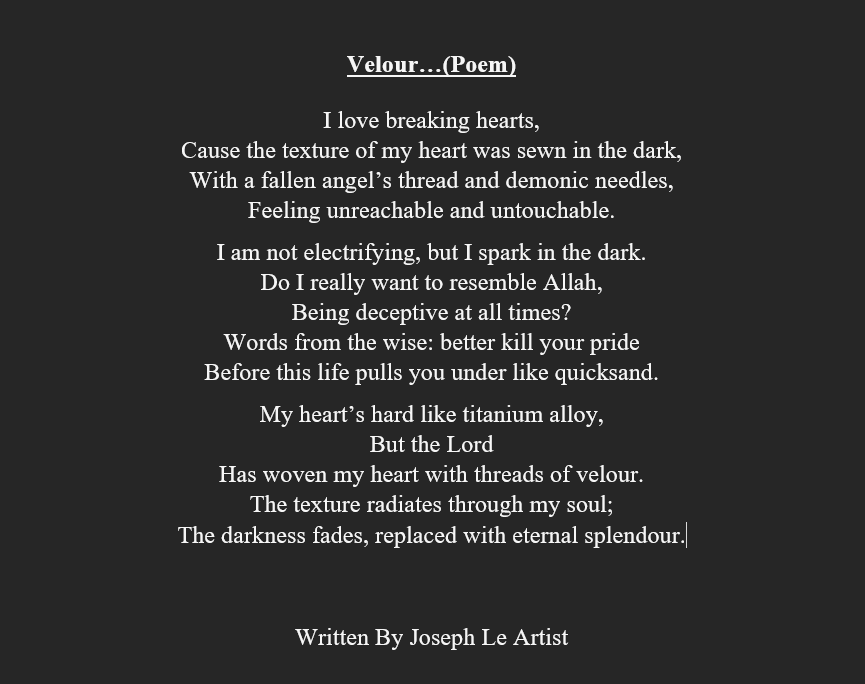
The human heart is a paradox—a fragile yet resilient tapestry woven with threads of light and shadow. In a poignant poem that confesses, “I love breaking hearts,” we encounter a voice grappling with pride, darkness, and the transformative power of divine grace. Central to this narrative is the imagery of “threads of velour,” a soft, luxurious fabric that symbolizes vulnerability, redemption, and the gentle touch of the divine. This article explores velour symbolism in poetry, tracing the speaker’s journey from a heart hardened by pride to one radiant with eternal splendour, and what it reveals about spiritual redemption and human transformation.
The Dark Stitches of Pride: A Heart Sewn in Shadows
The poem opens with a bold declaration: “I love breaking hearts.” This isn’t merely a boast but a reflection of power—a desire to control others’ vulnerabilities in a chaotic world. The speaker’s heart, “sewn in the dark with a fallen angel’s thread and demonic needles,” is a creation born of rebellion. The “fallen angel” evokes pride, the sin that led to celestial downfall, while “demonic needles” suggest pain and defiance. This imagery paints a heart that is “unreachable and untouchable,” armored against connection.
Yet, a flicker of potential emerges: “I am not electrifying, but I spark in the dark.” This spark hints at latent energy, a possibility for illumination amidst the shadows. The tension between destruction and creation sets the stage for the poem’s exploration of heart transformation, where velour symbolism will later play a pivotal role.
The Weight of Pride: A Deceptive Ambition
The speaker’s introspection deepens with a provocative question: “Do I really want to resemble Allah, being deceptive at all times?” This line confronts the allure of godlike power through manipulation. In Islamic theology, Allah embodies truth, free from deceit. The speaker’s ambition to mimic divine authority reveals pride’s deceptive grip, a theme central to spiritual redemption.
The poem offers wisdom: “Words from the wise: better kill your pride before this life pulls you under like quicksand.” Pride, likened to quicksand, engulfs slowly, trapping us in isolation. This metaphor resonates with readers seeking insights into pride and humility, marking a turning point where the speaker’s hardened heart begins to soften, setting the stage for velour’s transformative role.
Velour Symbolism: The Divine Thread of Grace
At the poem’s heart lies a powerful shift: “My heart’s hard like titanium alloy, but the Lord has woven my heart with threads of velour.” Titanium alloy, unyielding and resistant, symbolizes a heart fortified against vulnerability. In contrast, velour—a soft, plush fabric—represents divine grace and emotional openness. Velour symbolism in poetry evokes luxury not in a material sense but as a spiritual wealth, a tender reweaving of the soul.
The act of weaving velour into the speaker’s heart is intimate and deliberate, suggesting a patient divine intervention. Unlike the coarse “fallen angel’s thread,” velour is warm and inviting, radiating “through my soul.” This transformation dissolves the darkness, replacing it with “eternal splendour.” Velour becomes a metaphor for vulnerability as strength, a key theme in heart transformation poetry.
The Universal Journey: From Darkness to Splendour
The poem’s narrative mirrors the human condition—a struggle between our darker impulses and the call to redemption. The “fallen angel’s thread” represents wounds like pride or trauma, while “threads of velour” symbolize healing through surrender. Velour symbolism in poetry offers a universal lens for understanding transformation, whether through faith, love, or self-awareness.
The “eternal splendour” that emerges is a radiant light born of a softened heart. Velour, with its reflective surface, becomes the medium for this light, symbolizing the soul’s capacity to reflect grace. This resonates with readers exploring spiritual redemption, as the poem suggests no heart is too hard to be touched, no darkness too deep to be illuminated.
Conclusion: A Heart Rewoven with Velour
The poem’s journey from a heart that breaks others to one woven with velour is a testament to the power of vulnerability. Velour symbolism in poetry captures the gentle, transformative touch of divine grace, unravelling pride to reveal eternal splendour. For readers, it’s a reminder that our hearts, though stitched with shadows, can be rewoven with light.
IntroAlex O’Connor Hypocrisy On Animal Suffering is a thought-provoking philosophical essay (likely from a debate or analysis channel) that challenges the common atheist argument against God’s existence based on animal suffering. It argues that such critiques can be hypocritical, as they often ignore humanity’s own massive role in causing and perpetuating animal pain through factory…
Intro Before I crossed the threshold into that pulsing underworld, I handed my soul to a fallen angel at the door—sealing a Faustian bargain for women who existed only in virtual promise, illusions spun from desire and digital haze. Inside, the club drowned in dark misty buzz, hypnotic music clamping my mind like a vice…
Intro In the shadowed attic of old grief, I found those frantic, handwritten letters—blasphemies scratched out by a younger me during a season of unrelenting calamity, heart emptied by pain and the lack of any real help. One page, opened on a whim, carried the desperate lie: “cursing God will fill your pocket with freedom…
Intro Sometimes I think about why the urge to create feels so natural, almost unavoidable, as if it was placed inside us long before we understood what art even was. It makes me wonder if creativity is part of the reason we exist at all—like God invented us so imagination could move through human hands…
Intro In an age where virtue is performed beneath studio lights and righteousness is rehearsed for applause, the loudest saviors often cast the longest shadows. History has shown how public personas can crumble — from the fall of R. Kelly to the scandal surrounding Jeffrey Epstein — revealing how influence and power can conceal disturbing…
IntroThis poem presents a sharp and cautionary portrait of a woman whose outer beauty conceals inner danger. By comparing her appearance to Stacy Dash, the speaker immediately establishes an image of striking physical attractiveness, only to contrast it with the darker image of a “fallen angel.” Throughout the poem, religious symbolism—halos, horns, heaven—blends with modern…
IntroPurpose and destiny have always guided me, embodied in figures like Tia and Tamara, whose presence kept me steady and focused on achieving higher victories. Their influence lit a path toward growth and fulfillment, shaping my choices and ambitions. Yet, life’s temptations came in the form of vices resembling Samara, pulling me toward darker paths…
IntroThrough powerful biblical symbolism and vivid, confrontational imagery, the poem examines the complex tension between femininity, masculinity, and authority. By invoking Moses parting the Red Sea as a metaphor for spiritual revelation and division, the speaker establishes a dramatic tone that carries throughout the piece. The contrasting portrayals of “quiet and feminine grace” against loud,…
IntroThrough powerful biblical symbolism and vivid, confrontational imagery, the poem examines the complex tension between femininity, masculinity, and authority. By invoking Moses parting the Red Sea as a metaphor for spiritual revelation and division, the speaker establishes a dramatic tone that carries throughout the piece. The contrasting portrayals of “quiet and feminine grace” against loud,…
Intro“King Solomon Size” evokes the legendary magnitude of love and desire associated with Solomon, using his grand reputation as a metaphor for vast romantic ambition. The poem speaks in the voice of a man who longs to warm his “cold and dark” heart through touch, admiration, and conquest, revealing both vulnerability and hunger for devotion.…
Dissected Threads
Tread One : Threads of Velour: The Symbolism of Heart Transformation in Poetry.(Blog)
IntroAlex O’Connor Hypocrisy On Animal Suffering is a thought-provoking philosophical essay (likely from a debate or analysis channel) that challenges the common atheist argument against God’s existence based on animal suffering. It argues that such critiques can be hypocritical, as they often ignore humanity’s own massive role in causing and perpetuating animal pain through factory…
Intro Before I crossed the threshold into that pulsing underworld, I handed my soul to a fallen angel at the door—sealing a Faustian bargain for women who existed only in virtual promise, illusions spun from desire and digital haze. Inside, the club drowned in dark misty buzz, hypnotic music clamping my mind like a vice…
Intro In the shadowed attic of old grief, I found those frantic, handwritten letters—blasphemies scratched out by a younger me during a season of unrelenting calamity, heart emptied by pain and the lack of any real help. One page, opened on a whim, carried the desperate lie: “cursing God will fill your pocket with freedom…
Intro Sometimes I think about why the urge to create feels so natural, almost unavoidable, as if it was placed inside us long before we understood what art even was. It makes me wonder if creativity is part of the reason we exist at all—like God invented us so imagination could move through human hands…
Intro In an age where virtue is performed beneath studio lights and righteousness is rehearsed for applause, the loudest saviors often cast the longest shadows. History has shown how public personas can crumble — from the fall of R. Kelly to the scandal surrounding Jeffrey Epstein — revealing how influence and power can conceal disturbing…
IntroThis poem presents a sharp and cautionary portrait of a woman whose outer beauty conceals inner danger. By comparing her appearance to Stacy Dash, the speaker immediately establishes an image of striking physical attractiveness, only to contrast it with the darker image of a “fallen angel.” Throughout the poem, religious symbolism—halos, horns, heaven—blends with modern…
IntroPurpose and destiny have always guided me, embodied in figures like Tia and Tamara, whose presence kept me steady and focused on achieving higher victories. Their influence lit a path toward growth and fulfillment, shaping my choices and ambitions. Yet, life’s temptations came in the form of vices resembling Samara, pulling me toward darker paths…
IntroThrough powerful biblical symbolism and vivid, confrontational imagery, the poem examines the complex tension between femininity, masculinity, and authority. By invoking Moses parting the Red Sea as a metaphor for spiritual revelation and division, the speaker establishes a dramatic tone that carries throughout the piece. The contrasting portrayals of “quiet and feminine grace” against loud,…
IntroThrough powerful biblical symbolism and vivid, confrontational imagery, the poem examines the complex tension between femininity, masculinity, and authority. By invoking Moses parting the Red Sea as a metaphor for spiritual revelation and division, the speaker establishes a dramatic tone that carries throughout the piece. The contrasting portrayals of “quiet and feminine grace” against loud,…
Intro“King Solomon Size” evokes the legendary magnitude of love and desire associated with Solomon, using his grand reputation as a metaphor for vast romantic ambition. The poem speaks in the voice of a man who longs to warm his “cold and dark” heart through touch, admiration, and conquest, revealing both vulnerability and hunger for devotion.…
Dissected Threads
Tread One :
Inspiration from :
IntroAlex O’Connor Hypocrisy On Animal Suffering is a thought-provoking philosophical essay (likely from a debate or analysis channel) that challenges the common atheist argument against God’s existence based on animal suffering. It argues that such critiques can be hypocritical, as they often ignore humanity’s own massive role in causing and perpetuating animal pain through factory…
Intro Before I crossed the threshold into that pulsing underworld, I handed my soul to a fallen angel at the door—sealing a Faustian bargain for women who existed only in virtual promise, illusions spun from desire and digital haze. Inside, the club drowned in dark misty buzz, hypnotic music clamping my mind like a vice…
Intro In the shadowed attic of old grief, I found those frantic, handwritten letters—blasphemies scratched out by a younger me during a season of unrelenting calamity, heart emptied by pain and the lack of any real help. One page, opened on a whim, carried the desperate lie: “cursing God will fill your pocket with freedom…
Intro Sometimes I think about why the urge to create feels so natural, almost unavoidable, as if it was placed inside us long before we understood what art even was. It makes me wonder if creativity is part of the reason we exist at all—like God invented us so imagination could move through human hands…
Intro In an age where virtue is performed beneath studio lights and righteousness is rehearsed for applause, the loudest saviors often cast the longest shadows. History has shown how public personas can crumble — from the fall of R. Kelly to the scandal surrounding Jeffrey Epstein — revealing how influence and power can conceal disturbing…
IntroThis poem presents a sharp and cautionary portrait of a woman whose outer beauty conceals inner danger. By comparing her appearance to Stacy Dash, the speaker immediately establishes an image of striking physical attractiveness, only to contrast it with the darker image of a “fallen angel.” Throughout the poem, religious symbolism—halos, horns, heaven—blends with modern…
IntroPurpose and destiny have always guided me, embodied in figures like Tia and Tamara, whose presence kept me steady and focused on achieving higher victories. Their influence lit a path toward growth and fulfillment, shaping my choices and ambitions. Yet, life’s temptations came in the form of vices resembling Samara, pulling me toward darker paths…
IntroThrough powerful biblical symbolism and vivid, confrontational imagery, the poem examines the complex tension between femininity, masculinity, and authority. By invoking Moses parting the Red Sea as a metaphor for spiritual revelation and division, the speaker establishes a dramatic tone that carries throughout the piece. The contrasting portrayals of “quiet and feminine grace” against loud,…
IntroThrough powerful biblical symbolism and vivid, confrontational imagery, the poem examines the complex tension between femininity, masculinity, and authority. By invoking Moses parting the Red Sea as a metaphor for spiritual revelation and division, the speaker establishes a dramatic tone that carries throughout the piece. The contrasting portrayals of “quiet and feminine grace” against loud,…
Intro“King Solomon Size” evokes the legendary magnitude of love and desire associated with Solomon, using his grand reputation as a metaphor for vast romantic ambition. The poem speaks in the voice of a man who longs to warm his “cold and dark” heart through touch, admiration, and conquest, revealing both vulnerability and hunger for devotion.…
The human experience is a tapestry woven with threads of joy and sorrow, laughter and despair, each strand inseparable from the other. Few mediums capture this duality as vividly as comedy, a craft that transforms the absurdities and pains of existence into moments of shared catharsis. Yet, beneath the surface of every laugh lies a deeper question: What does it mean to find meaning in a world where happiness is fleeting and suffering is inevitable? Through the lens of comedy, and with a nod to the life and legacy of comedian and actor Robin Williams, we can explore the existential, psychological, and societal dimensions of this paradox, confronting the masks we wear, the voids we seek to fill, and the fragile beauty of our shared humanity.
The Comic as Existential Rebel: Laughter Against the Void
Philosophers have long grappled with the absurdity of existence. Albert Camus, in The Myth of Sisyphus, argued that life lacks inherent meaning, yet we must rebel against this absurdity by creating our own purpose. Comedy is one such rebellion—an act of defiance that transforms chaos into connection. The comedian, armed with wit and vulnerability, stands before the void and dares to laugh. This act is not mere entertainment but a philosophical stance, asserting humanity’s resilience in the face of an indifferent universe.
Comedy’s power lies in its ability to hold a mirror to our contradictions. It reveals the ridiculousness of our pretensions, the fragility of our certainties, and the universality of our struggles. Søren Kierkegaard, reflecting on the nature of existence, noted that “the same thing that makes one laugh makes one cry.” This interplay is the heart of comedy’s philosophical weight: it does not deny suffering but embraces it, weaving it into a shared experience that momentarily transcends isolation. The comedian becomes a guide, navigating the tension between despair and hope, inviting us to laugh at our own impermanence.
The Mask of the Jester: Comedy as a Double-Edged Sword
Yet, comedy is not always liberation; it can also be a mask. Sigmund Freud viewed humor as a defense mechanism, a way to deflect pain by reframing it. For the comedian, the stage becomes both a sanctuary and a prison—a space to externalize anguish but also a demand to perform joy on command. This paradox raises a profound question: Can one ever truly escape suffering through performance? Jean-Paul Sartre’s concept of “bad faith” suggests that living inauthentically—hiding one’s true self behind a role—leads to existential alienation. The comedian who dons the mask of mirth risks losing touch with their own humanity, trapped in a cycle of expectation and denial.
This tension is poignantly illustrated in the life of Robin Williams, whose frenetic energy and emotional depth left an indelible mark on comedy and cinema. Robin Williams (1951–2014), an American comedian and actor, was renowned for his improvisational genius in films like Good Morning, Vietnam (1987), Dead Poets Society (1989), Good Will Hunting (1997), and Mrs. Doubtfire (1993). His vibrant humor masked struggles with depression, addiction, and Lewy body dementia, culminating in his tragic suicide. Williams’ legacy reflects the interplay of laughter and pain, embodying the human condition’s complexity. His performances, whether as the irreverent DJ Adrian Cronauer or the grief-stricken therapist Sean Maguire, revealed a man who could pivot from hilarity to heartbreak, embodying Kierkegaard’s insight. In a 1991 Playboy interview, Williams described his stage persona as a “shield,” a way to outrun sadness. Yet, as the poet in the original query laments—“More vice, more plight, more numbness… Only to see suicide face to face”—the pursuit of “more” could not fill the void. Williams’ death in 2014 laid bare the limits of comedy as salvation, forcing us to confront the fragility of the masks we all wear.
The Social Mirror: Comedy as Collective Catharsis
Beyond the individual, comedy serves a societal function, holding a mirror to humanity’s flaws and aspirations. Henri Bergson argued that laughter corrects social rigidity, mocking inflexibility to foster fluidity and connection. The comedian, in this sense, is a cultural alchemist, transforming collective anxieties into shared relief. Williams’ work exemplified this role. In The Birdcage (1996), he championed acceptance through humor; in Mrs. Doubtfire, he explored the absurdity and tenderness of family. His improvisational style—wild, inclusive, and deeply human—invited audiences to laugh at their own imperfections, forging unity in a fractured world.
Yet, society often demands that comedians remain “on,” perpetuating the myth of the eternal jester. This expectation can be a form of exploitation, ignoring the humanity behind the performer’s mask. Hannah Arendt’s concept of the “banality of evil” finds a parallel in the banality of neglect—failing to see the person beneath the persona. Williams’ struggles with mental health were compounded by this pressure, as fans and media craved the next quip, the next burst of brilliance. His death sparked vital conversations about mental health and the cost of fame, but it also exposed our collective complicity in idealizing the “happy clown.” This raises an ethical question: How do we honor the humanity of those who make us laugh, without reducing them to mere vessels of joy?
The Fragile Beauty of Being Human
In the end, comedy’s philosophical depth lies in its embrace of the human condition in all its messiness. It does not resolve the tension between joy and sorrow but holds space for both, reminding us that to laugh is to live, even in the shadow of loss. Williams’ legacy is a testament to this truth. His performances were not escapes from pain but confrontations with it, offering moments of connection that linger long after the laughter fades. As Camus wrote, “One must imagine Sisyphus happy.” So too must we imagine the comedian—Williams included—finding fleeting joy in the act of rebellion, even as the boulder of existence rolls back down.
The poet’s lament—“As I hang myself, giving my final comedic sketch on stage”—captures the tragic irony of a life spent chasing laughter only to face despair. Yet, in Williams’ case, the stage was also a gift, a space where he touched millions with his humanity. His life invites us to reflect on our own masks, our own voids, and the ways we seek meaning. To laugh, to cry, to connect—these are not solutions to the absurdity of existence but affirmations of it. In the delicate balance of comedy and tragedy, we glimpse the fragile beauty of being human, a beauty that Robin Williams, in all his brilliance and brokenness, embodied until the end.
 LifeandTimelessart