Dissected Treads
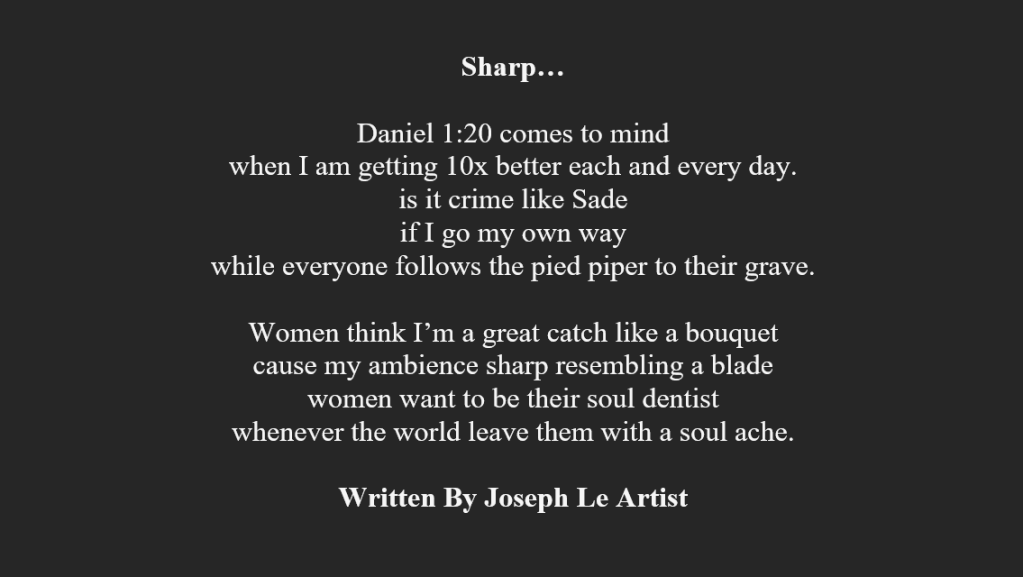
Tread One : Growing 10x Better:
Journey of Self-Improvement and Authentic Allure
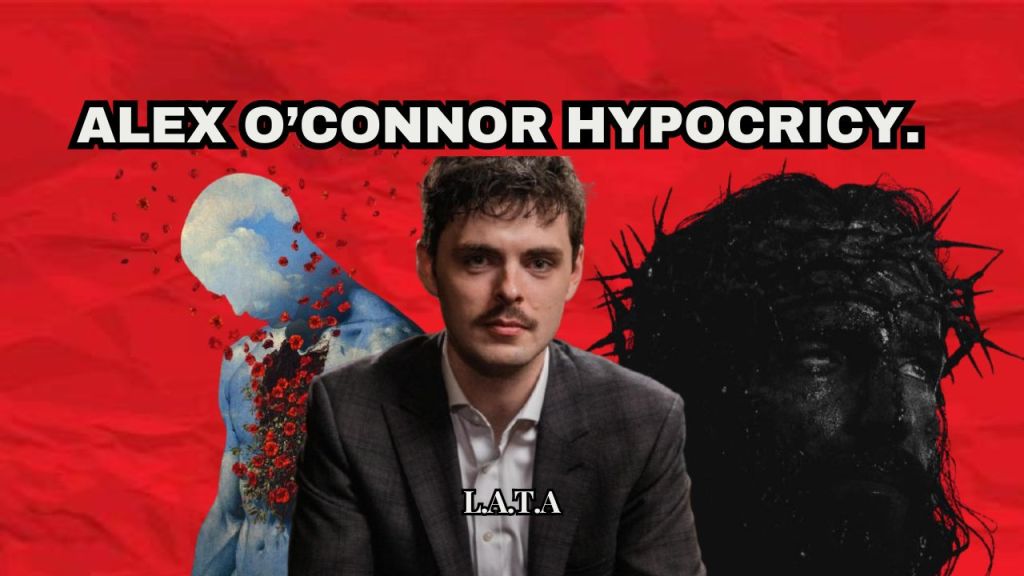
IntroAlex O’Connor Hypocrisy On Animal Suffering is a thought-provoking philosophical essay (likely from a debate or analysis channel) that challenges the common atheist argument against God’s existence based on animal suffering. It argues that such critiques can be hypocritical, as they often ignore humanity’s own massive role in causing and perpetuating animal pain through factory…
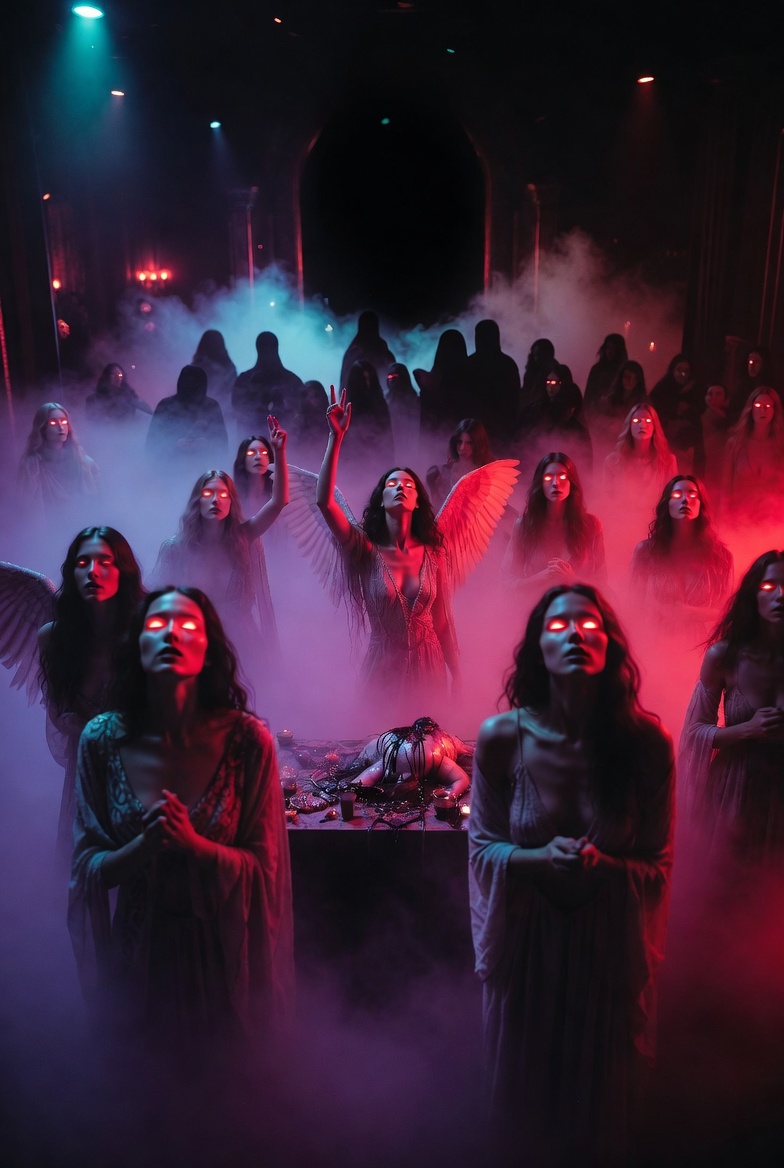
Intro Before I crossed the threshold into that pulsing underworld, I handed my soul to a fallen angel at the door—sealing a Faustian bargain for women who existed only in virtual promise, illusions spun from desire and digital haze. Inside, the club drowned in dark misty buzz, hypnotic music clamping my mind like a vice…
Intro In the shadowed attic of old grief, I found those frantic, handwritten letters—blasphemies scratched out by a younger me during a season of unrelenting calamity, heart emptied by pain and the lack of any real help. One page, opened on a whim, carried the desperate lie: “cursing God will fill your pocket with freedom…
Intro Sometimes I think about why the urge to create feels so natural, almost unavoidable, as if it was placed inside us long before we understood what art even was. It makes me wonder if creativity is part of the reason we exist at all—like God invented us so imagination could move through human hands…

Intro In an age where virtue is performed beneath studio lights and righteousness is rehearsed for applause, the loudest saviors often cast the longest shadows. History has shown how public personas can crumble — from the fall of R. Kelly to the scandal surrounding Jeffrey Epstein — revealing how influence and power can conceal disturbing…

IntroThis poem presents a sharp and cautionary portrait of a woman whose outer beauty conceals inner danger. By comparing her appearance to Stacy Dash, the speaker immediately establishes an image of striking physical attractiveness, only to contrast it with the darker image of a “fallen angel.” Throughout the poem, religious symbolism—halos, horns, heaven—blends with modern…

IntroPurpose and destiny have always guided me, embodied in figures like Tia and Tamara, whose presence kept me steady and focused on achieving higher victories. Their influence lit a path toward growth and fulfillment, shaping my choices and ambitions. Yet, life’s temptations came in the form of vices resembling Samara, pulling me toward darker paths…
IntroThrough powerful biblical symbolism and vivid, confrontational imagery, the poem examines the complex tension between femininity, masculinity, and authority. By invoking Moses parting the Red Sea as a metaphor for spiritual revelation and division, the speaker establishes a dramatic tone that carries throughout the piece. The contrasting portrayals of “quiet and feminine grace” against loud,…

IntroThrough powerful biblical symbolism and vivid, confrontational imagery, the poem examines the complex tension between femininity, masculinity, and authority. By invoking Moses parting the Red Sea as a metaphor for spiritual revelation and division, the speaker establishes a dramatic tone that carries throughout the piece. The contrasting portrayals of “quiet and feminine grace” against loud,…
Intro“King Solomon Size” evokes the legendary magnitude of love and desire associated with Solomon, using his grand reputation as a metaphor for vast romantic ambition. The poem speaks in the voice of a man who longs to warm his “cold and dark” heart through touch, admiration, and conquest, revealing both vulnerability and hunger for devotion.…
IntroAlex O’Connor Hypocrisy On Animal Suffering is a thought-provoking philosophical essay (likely from a debate or analysis channel) that challenges the common atheist argument against God’s existence based on animal suffering. It argues that such critiques can be hypocritical, as they often ignore humanity’s own massive role in causing and perpetuating animal pain through factory…
Intro Before I crossed the threshold into that pulsing underworld, I handed my soul to a fallen angel at the door—sealing a Faustian bargain for women who existed only in virtual promise, illusions spun from desire and digital haze. Inside, the club drowned in dark misty buzz, hypnotic music clamping my mind like a vice…
Intro In the shadowed attic of old grief, I found those frantic, handwritten letters—blasphemies scratched out by a younger me during a season of unrelenting calamity, heart emptied by pain and the lack of any real help. One page, opened on a whim, carried the desperate lie: “cursing God will fill your pocket with freedom…
Intro Sometimes I think about why the urge to create feels so natural, almost unavoidable, as if it was placed inside us long before we understood what art even was. It makes me wonder if creativity is part of the reason we exist at all—like God invented us so imagination could move through human hands…
Intro In an age where virtue is performed beneath studio lights and righteousness is rehearsed for applause, the loudest saviors often cast the longest shadows. History has shown how public personas can crumble — from the fall of R. Kelly to the scandal surrounding Jeffrey Epstein — revealing how influence and power can conceal disturbing…
IntroThis poem presents a sharp and cautionary portrait of a woman whose outer beauty conceals inner danger. By comparing her appearance to Stacy Dash, the speaker immediately establishes an image of striking physical attractiveness, only to contrast it with the darker image of a “fallen angel.” Throughout the poem, religious symbolism—halos, horns, heaven—blends with modern…
IntroPurpose and destiny have always guided me, embodied in figures like Tia and Tamara, whose presence kept me steady and focused on achieving higher victories. Their influence lit a path toward growth and fulfillment, shaping my choices and ambitions. Yet, life’s temptations came in the form of vices resembling Samara, pulling me toward darker paths…
IntroThrough powerful biblical symbolism and vivid, confrontational imagery, the poem examines the complex tension between femininity, masculinity, and authority. By invoking Moses parting the Red Sea as a metaphor for spiritual revelation and division, the speaker establishes a dramatic tone that carries throughout the piece. The contrasting portrayals of “quiet and feminine grace” against loud,…
IntroThrough powerful biblical symbolism and vivid, confrontational imagery, the poem examines the complex tension between femininity, masculinity, and authority. By invoking Moses parting the Red Sea as a metaphor for spiritual revelation and division, the speaker establishes a dramatic tone that carries throughout the piece. The contrasting portrayals of “quiet and feminine grace” against loud,…
Intro“King Solomon Size” evokes the legendary magnitude of love and desire associated with Solomon, using his grand reputation as a metaphor for vast romantic ambition. The poem speaks in the voice of a man who longs to warm his “cold and dark” heart through touch, admiration, and conquest, revealing both vulnerability and hunger for devotion.…
Becoming the Barbaric King: A Poem of Prophecy, Guilt, and 2 Kings 8:13 (Poem)…
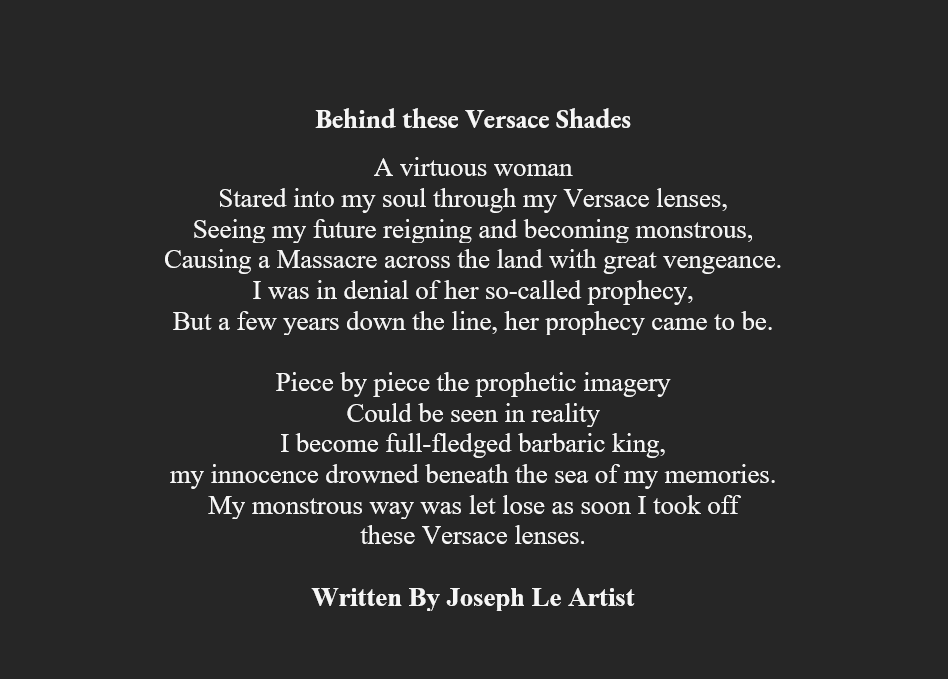
I sit with my poem, its words like scars I can’t ignore, trying to understand how I became the man I am. Writing this poem about prophecy and transformation felt like tearing open a wound, but I had to face the truth. It starts with a moment burned into my memory: I stood there, my Versace lenses gleaming, feeling untouchable. Then a virtuous woman appeared, her gaze piercing my shades, seeing straight to my soul. She spoke of a dark future—a barbaric king, me, ruling with vengeance, causing a massacre across the land. I laughed, denying her prophecy. Me, a monster? I was just a guy with style, not a tyrant. But her words lingered, heavy and sharp, and my poem traces how they came true.
The Versace Lenses: My Shield of Denial
The poem begins with those Versace lenses, a symbol of my denial. They weren’t just sunglasses—they were my way of hiding from the truth. Through them, the world seemed softer, and I could pretend I was innocent, untouched by the darkness she saw. I’d catch my reflection, all polish and confidence, and think, This is who I am. But deep down, I knew I was lying. I didn’t want to face the part of me that could become her prophecy—a man driven by power, capable of cruelty. So I pushed her words away, telling myself I’d never change. The poem captures that struggle, showing how I clung to those lenses to avoid my own potential for destruction.
My Art Born of Heat
In the film, bodies clash—desire’s a battlefield, physical and fraught. But for me, my caramel fever transcends that; it’s not just her skin I admire, it’s the fire it sparks. I write “fiery murals scattered around the apartment rooms,” and I mean it—every line I pen is a brushstroke, turning heat into art. I think Aristotle might get it: this isn’t desire for its own sake but for what it makes possible. While Lee’s characters stumble through their fever’s fallout, I’m building something—words that glow, murals that hold my soul’s blaze steady.
A Prophecy Unfolds: My Choices, My Fall
As I wrote, I relived the years after her prophecy, watching it unfold bit by bit. Every choice—every moment I let anger win, or pride take over—brought her vision closer to reality. I’d hurt someone, cross a line, and hear her words echo: reigning and becoming monstrous. The poem doesn’t shy away from that truth. I fought to stay the man I was, but I felt the lenses slipping. Then came the day I tore them off, not because I had to, but because I wanted to. I chose to see the world clearly, to embrace the power inside me. I became that barbaric king, and for a moment, it felt like freedom. The poem lays bare how I made that choice, step by step, turning my back on the innocence I once held.
The Massacre: A Reflection of My Guilt
The heart of the poem is the massacre—blood spilled, lives broken, screams fading into silence. I wrote it plainly because that’s how it haunts me. It wasn’t just the world I destroyed—it was myself, the man I thought I’d always be. My innocence drowned beneath memories of every decision that led me here. I could’ve chosen differently—moments of kindness, restraint—but I didn’t. The poem is my confession: I caused this. Not her prophecy, not fate, but my own hands. Writing about guilt and redemption, I feel the weight of what I’ve done—the thrill of power, the pain of loss, knowing I can’t undo it. The poem holds that truth, raw and unfiltered.
2 Kings 8:13: A Scripture of Denial
A scripture keeps circling in my mind, from 2 Kings 8:13: “Hazael said, ‘How could your servant, a mere dog, accomplish such a feat?’” Hazael speaks to Elisha, shocked by a prophecy that he’ll become king and commit terrible acts. That’s me, standing in my Versace lenses, telling that virtuous woman, Me, a monster? I’m just a guy. His disbelief mirrors mine—I couldn’t imagine my hands holding a blood-soaked crown. But like Hazael, I made it real. The scripture underscores the poem’s theme of denying one’s potential for harm, only to see it come true through choices. It’s a reminder that we don’t always know what we’re capable of until we’re there, facing the consequences.
Why I Wrote the Poem
Writing this poem about personal transformation wasn’t just about confessing—it was about searching. For what? Maybe forgiveness, maybe a way back. The virtuous woman’s eyes still watch me, not judging, but seeing the truth. My innocence is gone, drowned deep, but the poem gives me a flicker of hope. It ends with the massacre, but I don’t think my story does. The scripture doesn’t offer answers—Hazael becomes what Elisha saw, and life moves on. But I’m still here, words in hand, asking what’s next. Can I be more than this barbaric king? The poem makes me believe I can try, that I owe it to the man I lost to find out.
A Journey Beyond the Page
This poem is my mirror, my truth, my chance to wrestle with prophecy, guilt, and redemption. If you’re searching for poetry about transformation, biblical reflections like 2 Kings 8:13, or stories of facing one’s darker side, I hope my words resonate. I wrote them to understand myself, but maybe they’ll speak to you too—about the choices we make, the masks we wear, and the hope we hold, even after everything falls apart.
IntroAlex O’Connor Hypocrisy On Animal Suffering is a thought-provoking philosophical essay (likely from a debate or analysis channel) that challenges the common atheist argument against God’s existence based on animal suffering. It argues that such critiques can be hypocritical, as they often ignore humanity’s own massive role in causing and perpetuating animal pain through factory…
Intro Before I crossed the threshold into that pulsing underworld, I handed my soul to a fallen angel at the door—sealing a Faustian bargain for women who existed only in virtual promise, illusions spun from desire and digital haze. Inside, the club drowned in dark misty buzz, hypnotic music clamping my mind like a vice…
Intro In the shadowed attic of old grief, I found those frantic, handwritten letters—blasphemies scratched out by a younger me during a season of unrelenting calamity, heart emptied by pain and the lack of any real help. One page, opened on a whim, carried the desperate lie: “cursing God will fill your pocket with freedom…
Intro Sometimes I think about why the urge to create feels so natural, almost unavoidable, as if it was placed inside us long before we understood what art even was. It makes me wonder if creativity is part of the reason we exist at all—like God invented us so imagination could move through human hands…
Intro In an age where virtue is performed beneath studio lights and righteousness is rehearsed for applause, the loudest saviors often cast the longest shadows. History has shown how public personas can crumble — from the fall of R. Kelly to the scandal surrounding Jeffrey Epstein — revealing how influence and power can conceal disturbing…
IntroThis poem presents a sharp and cautionary portrait of a woman whose outer beauty conceals inner danger. By comparing her appearance to Stacy Dash, the speaker immediately establishes an image of striking physical attractiveness, only to contrast it with the darker image of a “fallen angel.” Throughout the poem, religious symbolism—halos, horns, heaven—blends with modern…
IntroPurpose and destiny have always guided me, embodied in figures like Tia and Tamara, whose presence kept me steady and focused on achieving higher victories. Their influence lit a path toward growth and fulfillment, shaping my choices and ambitions. Yet, life’s temptations came in the form of vices resembling Samara, pulling me toward darker paths…
IntroThrough powerful biblical symbolism and vivid, confrontational imagery, the poem examines the complex tension between femininity, masculinity, and authority. By invoking Moses parting the Red Sea as a metaphor for spiritual revelation and division, the speaker establishes a dramatic tone that carries throughout the piece. The contrasting portrayals of “quiet and feminine grace” against loud,…
IntroThrough powerful biblical symbolism and vivid, confrontational imagery, the poem examines the complex tension between femininity, masculinity, and authority. By invoking Moses parting the Red Sea as a metaphor for spiritual revelation and division, the speaker establishes a dramatic tone that carries throughout the piece. The contrasting portrayals of “quiet and feminine grace” against loud,…
Intro“King Solomon Size” evokes the legendary magnitude of love and desire associated with Solomon, using his grand reputation as a metaphor for vast romantic ambition. The poem speaks in the voice of a man who longs to warm his “cold and dark” heart through touch, admiration, and conquest, revealing both vulnerability and hunger for devotion.…
IntroAlex O’Connor Hypocrisy On Animal Suffering is a thought-provoking philosophical essay (likely from a debate or analysis channel) that challenges the common atheist argument against God’s existence based on animal suffering. It argues that such critiques can be hypocritical, as they often ignore humanity’s own massive role in causing and perpetuating animal pain through factory…
Intro Before I crossed the threshold into that pulsing underworld, I handed my soul to a fallen angel at the door—sealing a Faustian bargain for women who existed only in virtual promise, illusions spun from desire and digital haze. Inside, the club drowned in dark misty buzz, hypnotic music clamping my mind like a vice…
Intro In the shadowed attic of old grief, I found those frantic, handwritten letters—blasphemies scratched out by a younger me during a season of unrelenting calamity, heart emptied by pain and the lack of any real help. One page, opened on a whim, carried the desperate lie: “cursing God will fill your pocket with freedom…
Intro Sometimes I think about why the urge to create feels so natural, almost unavoidable, as if it was placed inside us long before we understood what art even was. It makes me wonder if creativity is part of the reason we exist at all—like God invented us so imagination could move through human hands…
Intro In an age where virtue is performed beneath studio lights and righteousness is rehearsed for applause, the loudest saviors often cast the longest shadows. History has shown how public personas can crumble — from the fall of R. Kelly to the scandal surrounding Jeffrey Epstein — revealing how influence and power can conceal disturbing…
IntroThis poem presents a sharp and cautionary portrait of a woman whose outer beauty conceals inner danger. By comparing her appearance to Stacy Dash, the speaker immediately establishes an image of striking physical attractiveness, only to contrast it with the darker image of a “fallen angel.” Throughout the poem, religious symbolism—halos, horns, heaven—blends with modern…
IntroPurpose and destiny have always guided me, embodied in figures like Tia and Tamara, whose presence kept me steady and focused on achieving higher victories. Their influence lit a path toward growth and fulfillment, shaping my choices and ambitions. Yet, life’s temptations came in the form of vices resembling Samara, pulling me toward darker paths…
IntroThrough powerful biblical symbolism and vivid, confrontational imagery, the poem examines the complex tension between femininity, masculinity, and authority. By invoking Moses parting the Red Sea as a metaphor for spiritual revelation and division, the speaker establishes a dramatic tone that carries throughout the piece. The contrasting portrayals of “quiet and feminine grace” against loud,…
IntroThrough powerful biblical symbolism and vivid, confrontational imagery, the poem examines the complex tension between femininity, masculinity, and authority. By invoking Moses parting the Red Sea as a metaphor for spiritual revelation and division, the speaker establishes a dramatic tone that carries throughout the piece. The contrasting portrayals of “quiet and feminine grace” against loud,…
Intro“King Solomon Size” evokes the legendary magnitude of love and desire associated with Solomon, using his grand reputation as a metaphor for vast romantic ambition. The poem speaks in the voice of a man who longs to warm his “cold and dark” heart through touch, admiration, and conquest, revealing both vulnerability and hunger for devotion.…
My Fever’s Cinematic Echo
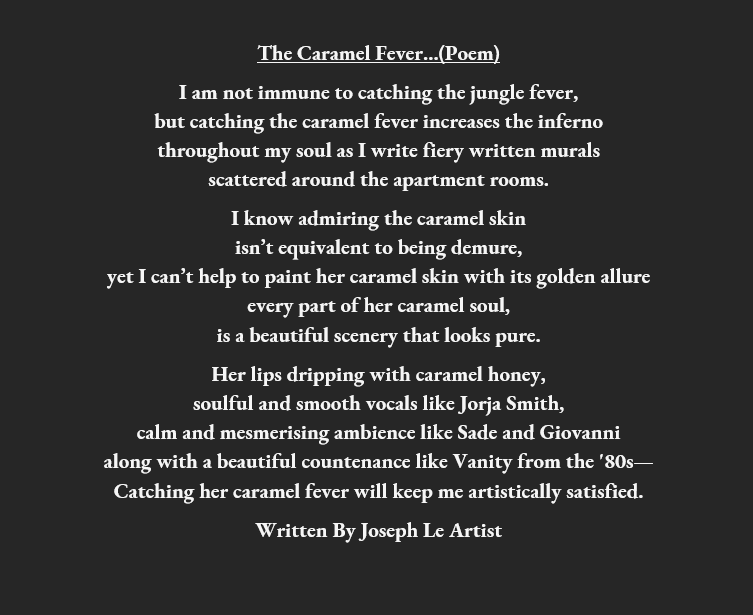
When I watch Spike Lee’s Jungle Fever, I see “jungle fever” unfold as a wild, tangled pull—Flipper and Angie caught in a taboo storm of interracial desire, weighed down by society’s glare. I feel that raw energy resonate when I write, “I am not immune to catching the jungle fever,” admitting I’m not above its primal grip. The film shows it tearing through lives, exposing prejudice and chaos, but I don’t linger there. Instead, I turn to something deeper—my “caramel fever”—a flame that flickers differently, hinting at a journey beyond what Lee’s lens captures.
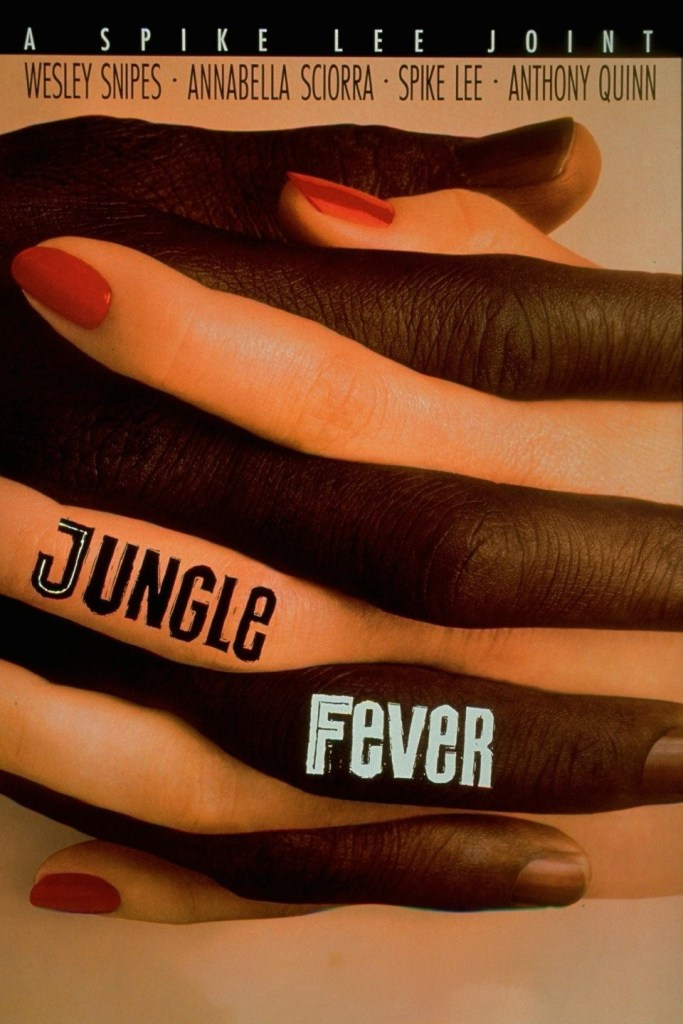
My Caramel Inferno
In Jungle Fever, desire crashes like a wave, leaving wreckage behind, but my caramel fever burns quieter, hotter, more personal. I feel it “increase the inferno throughout my soul,” not as destruction but as fuel. Unlike Flipper’s reckless fling with Angie, which unravels under outside pressure, my fever doesn’t answer to the world—it’s mine, igniting late-night scribbles and whispered lines. I’m not just chasing skin; I’m chasing something soulful, a fire that doesn’t fade but grows, warming the corners of my mind where creativity hums.
My Desire’s Many Faces
I’ve realized desire isn’t one thing—Lee’s jungle fever proves that with its messy, lust-driven chaos, all racial tension and broken bonds. I nod to it in my poem, but my caramel fever feels different, layered. It’s not a fleeting itch; it “increases,” spreading like ink across a page, steady and alive. I think of philosophers like Schopenhauer, who’d call desire a trap, but I disagree—I see it as a prism. Through one facet, I glimpse the film’s restless heat; through another, I find my own, a passion that doesn’t just take but gives me something to shape.
My Art Born of Heat
In the film, bodies clash—desire’s a battlefield, physical and fraught. But for me, my caramel fever transcends that; it’s not just her skin I admire, it’s the fire it sparks. I write “fiery murals scattered around the apartment rooms,” and I mean it—every line I pen is a brushstroke, turning heat into art. I think Aristotle might get it: this isn’t desire for its own sake but for what it makes possible. While Lee’s characters stumble through their fever’s fallout, I’m building something—words that glow, murals that hold my soul’s blaze steady.
My Fever’s Meaning
Looking back at Jungle Fever, I see Flipper’s story end in a loop—desire unresolved, a cry against the cycle. But I’ve found my way out, or maybe in. My caramel fever “murals the soul,” and I feel it as a kind of victory—a muse that drips honey and hums like Sade. I imagine Hegel nodding: jungle fever pulls me one way, the world’s judgment tugs another, and my caramel fever ties it together, lifting me higher. I call it “caramel” because it’s rich, warm, mine—a fever I don’t fight but wield, lighting up my pen and my purpose.
IntroAlex O’Connor Hypocrisy On Animal Suffering is a thought-provoking philosophical essay (likely from a debate or analysis channel) that challenges the common atheist argument against God’s existence based on animal suffering. It argues that such critiques can be hypocritical, as they often ignore humanity’s own massive role in causing and perpetuating animal pain through factory…
Intro Before I crossed the threshold into that pulsing underworld, I handed my soul to a fallen angel at the door—sealing a Faustian bargain for women who existed only in virtual promise, illusions spun from desire and digital haze. Inside, the club drowned in dark misty buzz, hypnotic music clamping my mind like a vice…
Intro In the shadowed attic of old grief, I found those frantic, handwritten letters—blasphemies scratched out by a younger me during a season of unrelenting calamity, heart emptied by pain and the lack of any real help. One page, opened on a whim, carried the desperate lie: “cursing God will fill your pocket with freedom…
Intro Sometimes I think about why the urge to create feels so natural, almost unavoidable, as if it was placed inside us long before we understood what art even was. It makes me wonder if creativity is part of the reason we exist at all—like God invented us so imagination could move through human hands…
Intro In an age where virtue is performed beneath studio lights and righteousness is rehearsed for applause, the loudest saviors often cast the longest shadows. History has shown how public personas can crumble — from the fall of R. Kelly to the scandal surrounding Jeffrey Epstein — revealing how influence and power can conceal disturbing…
IntroThis poem presents a sharp and cautionary portrait of a woman whose outer beauty conceals inner danger. By comparing her appearance to Stacy Dash, the speaker immediately establishes an image of striking physical attractiveness, only to contrast it with the darker image of a “fallen angel.” Throughout the poem, religious symbolism—halos, horns, heaven—blends with modern…
IntroPurpose and destiny have always guided me, embodied in figures like Tia and Tamara, whose presence kept me steady and focused on achieving higher victories. Their influence lit a path toward growth and fulfillment, shaping my choices and ambitions. Yet, life’s temptations came in the form of vices resembling Samara, pulling me toward darker paths…
IntroThrough powerful biblical symbolism and vivid, confrontational imagery, the poem examines the complex tension between femininity, masculinity, and authority. By invoking Moses parting the Red Sea as a metaphor for spiritual revelation and division, the speaker establishes a dramatic tone that carries throughout the piece. The contrasting portrayals of “quiet and feminine grace” against loud,…
IntroThrough powerful biblical symbolism and vivid, confrontational imagery, the poem examines the complex tension between femininity, masculinity, and authority. By invoking Moses parting the Red Sea as a metaphor for spiritual revelation and division, the speaker establishes a dramatic tone that carries throughout the piece. The contrasting portrayals of “quiet and feminine grace” against loud,…
Intro“King Solomon Size” evokes the legendary magnitude of love and desire associated with Solomon, using his grand reputation as a metaphor for vast romantic ambition. The poem speaks in the voice of a man who longs to warm his “cold and dark” heart through touch, admiration, and conquest, revealing both vulnerability and hunger for devotion.…
 LifeandTimelessart