Dissected Threads
Tread One :The Process…(Blog)...


The fourth Tread from “She Had To Go” (Poem):“The Taste of Memory” “Her blood touches my lips, reminiscing on the time when lust had its grip on me.” The slaughter was done, the blade of will had struck, and yet victory didn’t wipe the slate clean. Even in triumph, the residue lingers—a faint smear of…
Description The Third Tread from “Had to Let Go” (Poem):“The Slaughter of Temptation” “I slaughtered lust in its flesh before it could seduce me.” The words cut as sharply as the act they describe—a visceral, deliberate strike against a force that once held me captive. There came a moment of reckoning, a crossroads where the…
Description The Second Tread from “Had to Let Go” (Poem):“The Stain of Desire” All the bloodstains on me came from lustful desires in human form.” These words linger like an echo from a battlefield I never chose but couldn’t avoid. The marks I carry aren’t from battles with others—no swords or fists left these scars.…
Description The First Tread from “Had to Let Go” (Poem):“Philosophy of Trials” Life is not a gentle stream—it’s a forge, a crucible where the raw, unshaped essence of who we are is thrust into the flames. The trials and tribulations I’ve faced refined my soul like iron, stripping away the brittle edges and forging something…
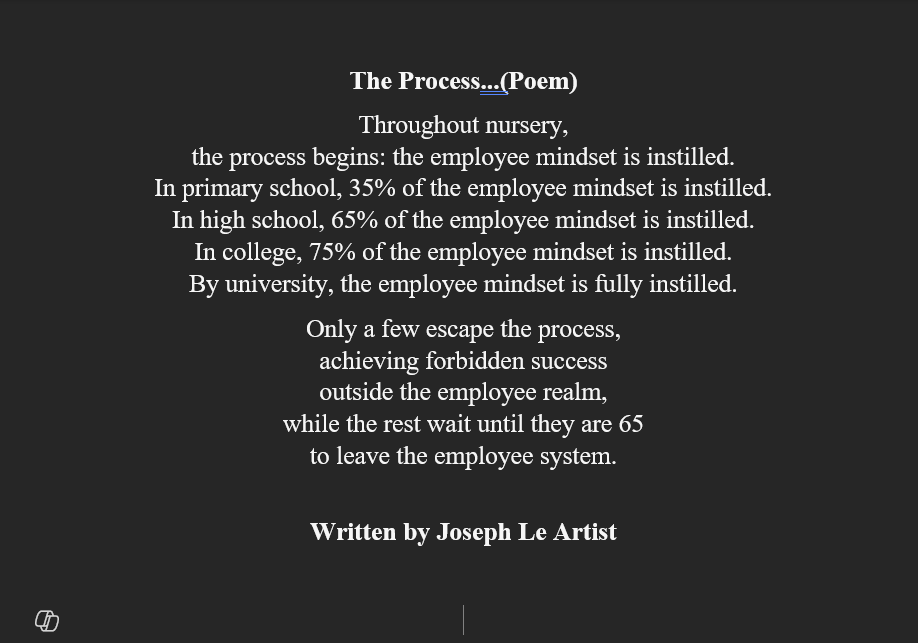
Description I’ve just broken free from the slave ship—that relentless 9-to-5 grind—and it hits me: what is freedom if not the rejection of a life that’s been handed to me? This system, this machine of control, can’t kill my vibe because I’ve seen through its illusion. It’s not just a job I’ve escaped; it’s the…

Description My neck feels like an art gallery, each chain hanging heavy around it, a showcase of my own making. Every single one of these chains tells a story—how my heart’s turning hollow and vain, emptying out with every link I add. I know I should be building something deeper, stacking up spiritual gains to…

Description This poem is a heartfelt ode to a woman admired for her intellectual and spiritual depth, blending biblical devotion with a complex interplay of personal qualities. Comprising seven lines, it follows an unstructured yet rhythmic flow, with no strict rhyme scheme but a clear cadence that mirrors the speaker’s reverence. The language is rich…

Description This poem explores the internal and external struggles of resisting temptation and upholding personal values in the face of superficial allure and societal pressure. The speaker begins by addressing an unnamed “you,” whose beauty mirrors vanity—suggesting a captivating yet potentially hollow charm. The speaker admits their vulnerability to this beauty, acknowledging that without the…
Treads Thread 1: The philosophy of Trials: How Struggles Refines the Soul… Thread 2 : The Philosophy of Trials: The Stain of Desire… Thread 3 : The Philosophy of Trials: The Slaughter of Temptation … Thread 4 : The Philosophy of Trials: The Taste Of Memories … Thread 5 : The Philosophy of Trials: The Triumph Of The Few …

Kendrick Lamar’s “Reincarnated” serves as a chilling continuation of the “For Sale?” interlude from To Pimp a Butterfly, where Lucy (short for Lucifer) tempts Kendrick with the promise of wealth, fame, and power in exchange for his soul. In To Pimp a Butterfly, Kendrick wrestles with this proposition, but by the time we arrive at…
The fourth Tread from “She Had To Go” (Poem):“The Taste of Memory” “Her blood touches my lips, reminiscing on the time when lust had its grip on me.” The slaughter was done, the blade of will had struck, and yet victory didn’t wipe the slate clean. Even in triumph, the residue lingers—a faint smear of…
Description The Third Tread from “Had to Let Go” (Poem):“The Slaughter of Temptation” “I slaughtered lust in its flesh before it could seduce me.” The words cut as sharply as the act they describe—a visceral, deliberate strike against a force that once held me captive. There came a moment of reckoning, a crossroads where the…
Description The Second Tread from “Had to Let Go” (Poem):“The Stain of Desire” All the bloodstains on me came from lustful desires in human form.” These words linger like an echo from a battlefield I never chose but couldn’t avoid. The marks I carry aren’t from battles with others—no swords or fists left these scars.…
Description The First Tread from “Had to Let Go” (Poem):“Philosophy of Trials” Life is not a gentle stream—it’s a forge, a crucible where the raw, unshaped essence of who we are is thrust into the flames. The trials and tribulations I’ve faced refined my soul like iron, stripping away the brittle edges and forging something…
Description I’ve just broken free from the slave ship—that relentless 9-to-5 grind—and it hits me: what is freedom if not the rejection of a life that’s been handed to me? This system, this machine of control, can’t kill my vibe because I’ve seen through its illusion. It’s not just a job I’ve escaped; it’s the…
Description My neck feels like an art gallery, each chain hanging heavy around it, a showcase of my own making. Every single one of these chains tells a story—how my heart’s turning hollow and vain, emptying out with every link I add. I know I should be building something deeper, stacking up spiritual gains to…
Description This poem is a heartfelt ode to a woman admired for her intellectual and spiritual depth, blending biblical devotion with a complex interplay of personal qualities. Comprising seven lines, it follows an unstructured yet rhythmic flow, with no strict rhyme scheme but a clear cadence that mirrors the speaker’s reverence. The language is rich…
Description This poem explores the internal and external struggles of resisting temptation and upholding personal values in the face of superficial allure and societal pressure. The speaker begins by addressing an unnamed “you,” whose beauty mirrors vanity—suggesting a captivating yet potentially hollow charm. The speaker admits their vulnerability to this beauty, acknowledging that without the…
Treads Thread 1: The philosophy of Trials: How Struggles Refines the Soul… Thread 2 : The Philosophy of Trials: The Stain of Desire… Thread 3 : The Philosophy of Trials: The Slaughter of Temptation … Thread 4 : The Philosophy of Trials: The Taste Of Memories … Thread 5 : The Philosophy of Trials: The Triumph Of The Few …
Kendrick Lamar’s “Reincarnated” serves as a chilling continuation of the “For Sale?” interlude from To Pimp a Butterfly, where Lucy (short for Lucifer) tempts Kendrick with the promise of wealth, fame, and power in exchange for his soul. In To Pimp a Butterfly, Kendrick wrestles with this proposition, but by the time we arrive at…
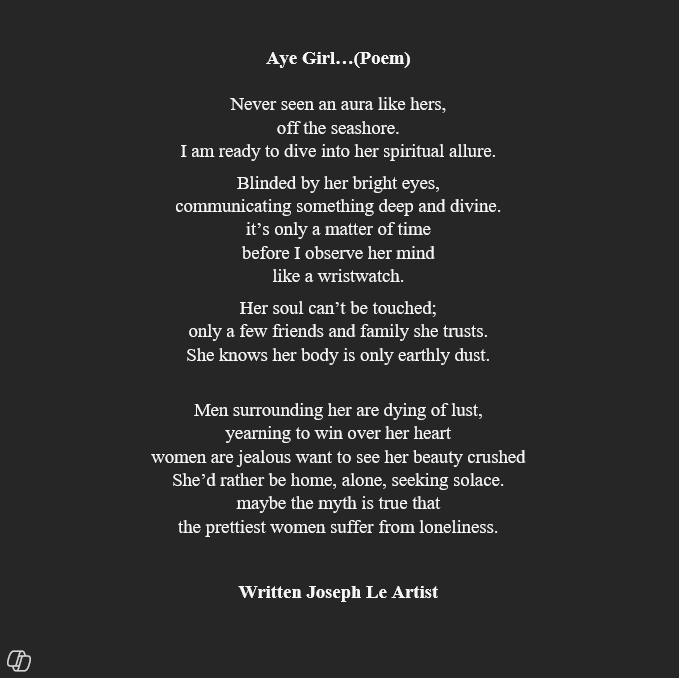
The cinematic portrayal of Malèna, in Giuseppe Tornatore’s 2000 film Malèna, serves as a profound allegory for the human condition, where beauty becomes both a divine gift and a crucible of existential isolation. Malèna, a woman of striking physical allure, navigates a Sicilian town steeped in patriarchal desire and judgment, her aura radiating a spiritual depth that transcends the superficial. Philosophically, her presence evokes Plato’s concept of the Ideal Form—beauty as a reflection of the divine, yet perpetually misunderstood by those bound to the material world. Her seashore solitude, as depicted in the film, mirrors the Stoic ideal of inner fortitude, where true strength lies in embracing one’s essence despite external clamor. Malèna’s beauty, like the poem’s “aura off the seashore,” invites us to question: Is beauty a bridge to the divine, or a veil that obscures the soul’s deeper truth?

The poem’s imagery of Malèna’s soul, trusted only by “a few friends and family,” and her body as “earthly dust,” resonates with the dualism of body and soul found in Augustine’s theology. Malèna knows her physical form is transient, a mere vessel subject to the lustful projections of others, yet her soul remains inviolable, a sacred enclave. This dichotomy mirrors the film’s portrayal of her as both idolized and ostracized, a paradox that echoes Heidegger’s concept of Geworfenheit—being “thrown” into a world that misunderstands one’s essence. Her choice to seek solace alone, “home all alone seeking solace,” aligns with the existentialist embrace of angst as a path to self-discovery. Malèna’s solitude is not mere withdrawal but a deliberate act of reclaiming her being, prompting us to ask: Is solitude the price of preserving one’s soul, or is it the only space where true communion with the divine occurs?
Ultimately, Malèna’s story, interwoven with the poem’s lyrical reverence, challenges us to confront the ephemeral nature of desire and the eternal quest for meaning. Her blush, yearned for by men “dying of lust,” symbolizes the fleeting nature of earthly passions, which crumble like dust against the timelessness of her spiritual allure. This evokes Spinoza’s pantheistic view of God as immanent in all things—Malèna’s beauty is not hers alone but a manifestation of the universal divine, misunderstood by those who see only the surface. Her journey, like the poem’s speaker observing her mind “like a wristwatch,” suggests a temporal struggle to grasp the eternal within the finite. Philosophically, Malèna becomes a cipher for the human soul’s paradox: to be seen yet unseen, to be desired yet unknowable. In her, we glimpse the eternal question: How do we reconcile the world’s gaze with the soul’s silent truth?
Dissected Threads
Tread One :
The fourth Tread from “She Had To Go” (Poem):“The Taste of Memory” “Her blood touches my lips, reminiscing on the time when lust had its grip on me.” The slaughter was done, the blade of will had struck, and yet victory didn’t wipe the slate clean. Even in triumph, the residue lingers—a faint smear of…
Description The Third Tread from “Had to Let Go” (Poem):“The Slaughter of Temptation” “I slaughtered lust in its flesh before it could seduce me.” The words cut as sharply as the act they describe—a visceral, deliberate strike against a force that once held me captive. There came a moment of reckoning, a crossroads where the…
Description The Second Tread from “Had to Let Go” (Poem):“The Stain of Desire” All the bloodstains on me came from lustful desires in human form.” These words linger like an echo from a battlefield I never chose but couldn’t avoid. The marks I carry aren’t from battles with others—no swords or fists left these scars.…
Description The First Tread from “Had to Let Go” (Poem):“Philosophy of Trials” Life is not a gentle stream—it’s a forge, a crucible where the raw, unshaped essence of who we are is thrust into the flames. The trials and tribulations I’ve faced refined my soul like iron, stripping away the brittle edges and forging something…
Description I’ve just broken free from the slave ship—that relentless 9-to-5 grind—and it hits me: what is freedom if not the rejection of a life that’s been handed to me? This system, this machine of control, can’t kill my vibe because I’ve seen through its illusion. It’s not just a job I’ve escaped; it’s the…
Description My neck feels like an art gallery, each chain hanging heavy around it, a showcase of my own making. Every single one of these chains tells a story—how my heart’s turning hollow and vain, emptying out with every link I add. I know I should be building something deeper, stacking up spiritual gains to…
Description This poem is a heartfelt ode to a woman admired for her intellectual and spiritual depth, blending biblical devotion with a complex interplay of personal qualities. Comprising seven lines, it follows an unstructured yet rhythmic flow, with no strict rhyme scheme but a clear cadence that mirrors the speaker’s reverence. The language is rich…
Description This poem explores the internal and external struggles of resisting temptation and upholding personal values in the face of superficial allure and societal pressure. The speaker begins by addressing an unnamed “you,” whose beauty mirrors vanity—suggesting a captivating yet potentially hollow charm. The speaker admits their vulnerability to this beauty, acknowledging that without the…
Treads Thread 1: The philosophy of Trials: How Struggles Refines the Soul… Thread 2 : The Philosophy of Trials: The Stain of Desire… Thread 3 : The Philosophy of Trials: The Slaughter of Temptation … Thread 4 : The Philosophy of Trials: The Taste Of Memories … Thread 5 : The Philosophy of Trials: The Triumph Of The Few …
Kendrick Lamar’s “Reincarnated” serves as a chilling continuation of the “For Sale?” interlude from To Pimp a Butterfly, where Lucy (short for Lucifer) tempts Kendrick with the promise of wealth, fame, and power in exchange for his soul. In To Pimp a Butterfly, Kendrick wrestles with this proposition, but by the time we arrive at…
Dissected Threads
Tread One :The Enigmatic Allure of Malèna: A Philosophical Reflection on Beauty, Isolation, and the Human Soul.
The fourth Tread from “She Had To Go” (Poem):“The Taste of Memory” “Her blood touches my lips, reminiscing on the time when lust had its grip on me.” The slaughter was done, the blade of will had struck, and yet victory didn’t wipe the slate clean. Even in triumph, the residue lingers—a faint smear of…
Description The Third Tread from “Had to Let Go” (Poem):“The Slaughter of Temptation” “I slaughtered lust in its flesh before it could seduce me.” The words cut as sharply as the act they describe—a visceral, deliberate strike against a force that once held me captive. There came a moment of reckoning, a crossroads where the…
Description The Second Tread from “Had to Let Go” (Poem):“The Stain of Desire” All the bloodstains on me came from lustful desires in human form.” These words linger like an echo from a battlefield I never chose but couldn’t avoid. The marks I carry aren’t from battles with others—no swords or fists left these scars.…
Description The First Tread from “Had to Let Go” (Poem):“Philosophy of Trials” Life is not a gentle stream—it’s a forge, a crucible where the raw, unshaped essence of who we are is thrust into the flames. The trials and tribulations I’ve faced refined my soul like iron, stripping away the brittle edges and forging something…
Description I’ve just broken free from the slave ship—that relentless 9-to-5 grind—and it hits me: what is freedom if not the rejection of a life that’s been handed to me? This system, this machine of control, can’t kill my vibe because I’ve seen through its illusion. It’s not just a job I’ve escaped; it’s the…
Description My neck feels like an art gallery, each chain hanging heavy around it, a showcase of my own making. Every single one of these chains tells a story—how my heart’s turning hollow and vain, emptying out with every link I add. I know I should be building something deeper, stacking up spiritual gains to…
Description This poem is a heartfelt ode to a woman admired for her intellectual and spiritual depth, blending biblical devotion with a complex interplay of personal qualities. Comprising seven lines, it follows an unstructured yet rhythmic flow, with no strict rhyme scheme but a clear cadence that mirrors the speaker’s reverence. The language is rich…
Description This poem explores the internal and external struggles of resisting temptation and upholding personal values in the face of superficial allure and societal pressure. The speaker begins by addressing an unnamed “you,” whose beauty mirrors vanity—suggesting a captivating yet potentially hollow charm. The speaker admits their vulnerability to this beauty, acknowledging that without the…
Treads Thread 1: The philosophy of Trials: How Struggles Refines the Soul… Thread 2 : The Philosophy of Trials: The Stain of Desire… Thread 3 : The Philosophy of Trials: The Slaughter of Temptation … Thread 4 : The Philosophy of Trials: The Taste Of Memories … Thread 5 : The Philosophy of Trials: The Triumph Of The Few …
Kendrick Lamar’s “Reincarnated” serves as a chilling continuation of the “For Sale?” interlude from To Pimp a Butterfly, where Lucy (short for Lucifer) tempts Kendrick with the promise of wealth, fame, and power in exchange for his soul. In To Pimp a Butterfly, Kendrick wrestles with this proposition, but by the time we arrive at…
The fourth Tread from “She Had To Go” (Poem):“The Taste of Memory” “Her blood touches my lips, reminiscing on the time when lust had its grip on me.” The slaughter was done, the blade of will had struck, and yet victory didn’t wipe the slate clean. Even in triumph, the residue lingers—a faint smear of…
Description The Third Tread from “Had to Let Go” (Poem):“The Slaughter of Temptation” “I slaughtered lust in its flesh before it could seduce me.” The words cut as sharply as the act they describe—a visceral, deliberate strike against a force that once held me captive. There came a moment of reckoning, a crossroads where the…
Description The Second Tread from “Had to Let Go” (Poem):“The Stain of Desire” All the bloodstains on me came from lustful desires in human form.” These words linger like an echo from a battlefield I never chose but couldn’t avoid. The marks I carry aren’t from battles with others—no swords or fists left these scars.…
Description The First Tread from “Had to Let Go” (Poem):“Philosophy of Trials” Life is not a gentle stream—it’s a forge, a crucible where the raw, unshaped essence of who we are is thrust into the flames. The trials and tribulations I’ve faced refined my soul like iron, stripping away the brittle edges and forging something…
Description I’ve just broken free from the slave ship—that relentless 9-to-5 grind—and it hits me: what is freedom if not the rejection of a life that’s been handed to me? This system, this machine of control, can’t kill my vibe because I’ve seen through its illusion. It’s not just a job I’ve escaped; it’s the…
Description My neck feels like an art gallery, each chain hanging heavy around it, a showcase of my own making. Every single one of these chains tells a story—how my heart’s turning hollow and vain, emptying out with every link I add. I know I should be building something deeper, stacking up spiritual gains to…
Description This poem is a heartfelt ode to a woman admired for her intellectual and spiritual depth, blending biblical devotion with a complex interplay of personal qualities. Comprising seven lines, it follows an unstructured yet rhythmic flow, with no strict rhyme scheme but a clear cadence that mirrors the speaker’s reverence. The language is rich…
Description This poem explores the internal and external struggles of resisting temptation and upholding personal values in the face of superficial allure and societal pressure. The speaker begins by addressing an unnamed “you,” whose beauty mirrors vanity—suggesting a captivating yet potentially hollow charm. The speaker admits their vulnerability to this beauty, acknowledging that without the…
Treads Thread 1: The philosophy of Trials: How Struggles Refines the Soul… Thread 2 : The Philosophy of Trials: The Stain of Desire… Thread 3 : The Philosophy of Trials: The Slaughter of Temptation … Thread 4 : The Philosophy of Trials: The Taste Of Memories … Thread 5 : The Philosophy of Trials: The Triumph Of The Few …
Kendrick Lamar’s “Reincarnated” serves as a chilling continuation of the “For Sale?” interlude from To Pimp a Butterfly, where Lucy (short for Lucifer) tempts Kendrick with the promise of wealth, fame, and power in exchange for his soul. In To Pimp a Butterfly, Kendrick wrestles with this proposition, but by the time we arrive at…
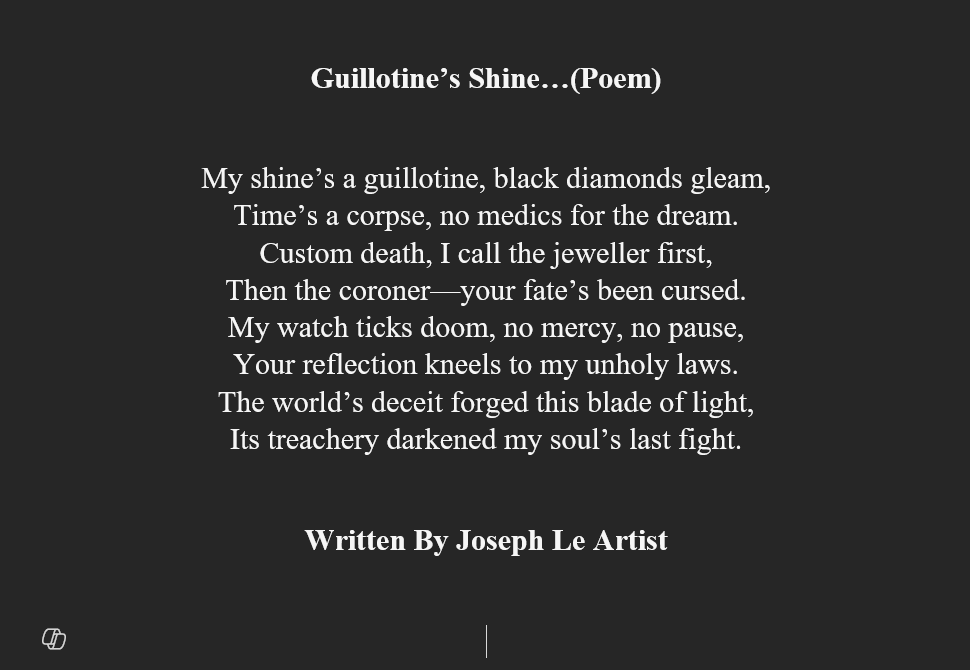
The line—“My shine’s a guillotine, black diamonds gleam, / Time’s a corpse, no medics for the dream. / Custom death, I call the jeweller first, / Then the coroner—your fate’s been cursed. / My watch ticks doom, no mercy, no pause, / Your reflection kneels to my unholy laws”—is a haunting exploration of power, mortality, and the human quest for meaning. Its vivid imagery, blending opulence with dread, challenges readers to confront existential and spiritual truths. The speaker’s godlike control and the relentless march of time create a tension that resonates across philosophical and biblical frameworks. This article unravels the philosophical and biblical meaning of the verse, delving into themes of vanity, time, mortality, and redemption, while inviting readers to reflect on its profound implications.
The Guillotine of Materialism
Philosophically, the verse wields a “guillotine” of materialism, its “black diamonds” symbolizing wealth’s seductive yet lethal allure. The speaker’s act of calling the jeweler before the coroner reveals a chilling hubris, as if death can be curated like a bespoke jewel. This godlike control, however, is undermined by time, depicted as a “corpse” with “no medics for the dream.” The imagery evokes Friedrich Nietzsche’s concept of the abyss, where human brilliance gazes into a void of meaninglessness. The guillotine’s gleam reflects a broader existential critique: wealth and power, though dazzling, are powerless against mortality’s blade. The verse thus challenges readers to question material pursuits, urging a search for purpose in the fleeting dreams that persist despite time’s decay. This resonates with existentialist thinkers like Jean-Paul Sartre, who emphasized creating meaning in an absurd, indifferent world.
Time’s Relentless Judgment
The “watch ticks doom” without mercy, and the “unholy laws” force reflections—others’ lives, hopes, or legacies—to kneel, painting a world where divine order is usurped by amoral sovereignty. Time’s indifference, a universal guillotine, cuts through all human constructs, from wealth to ambition. This relentless ticking aligns with Albert Camus’ absurdism, where humanity grapples with a universe devoid of inherent purpose. The speaker’s attempt to impose “unholy laws” mirrors a futile rebellion against time’s judgment, yet the kneeling reflections suggest that even this power is illusory. Philosophically, the verse invites us to embrace the fragile dream, finding meaning not in defying mortality but in living authentically within its shadow, a call to courage in the face of inevitable doom.
Biblical Warnings of Vanity
Biblically, the verse echoes the somber wisdom of Ecclesiastes: “All is vanity” (Ecclesiastes 1:2). The guillotine-shine and custom death mirror the Teacher’s critique of wealth as a fleeting pursuit, unable to outlast death’s curse (Ecclesiastes 2:11). The speaker’s “unholy laws” recall the pride of Babylon in Revelation, glittering with riches yet doomed to collapse (Revelation 18:7). Time’s corpse and the absence of medics evoke the Fall in Genesis, where death entered as humanity’s curse (Genesis 3:19). The speaker’s rebellion against divine authority underscores the futility of human power, akin to the Tower of Babel’s collapse (Genesis 11:4-9). This biblical lens reveals the verse as a cautionary tale, warning against the vanity of self-made sovereignty and the illusion of control over eternal consequences.
Redemption’s Hope Beyond Doom
In stark contrast to the verse’s nihilism, Scripture offers redemption: Christ’s resurrection triumphs over death’s guillotine, promising eternal life (1 Corinthians 15:54-57). While the speaker’s watch ticks doom, the biblical narrative points to a hope that transcends time’s corpse, urging pursuit of divine purpose over worldly gleam. This tension—despair versus salvation, vanity versus eternity—makes the verse a profound meditation on human existence. Its haunting beauty lies in its ability to provoke reflection, blending existential dread with spiritual possibility. Readers are invited to share their interpretations in the comments, exploring how this dark poetry speaks to life’s deepest questions and challenges us to seek meaning beyond the curse.



 LifeandTimelessart