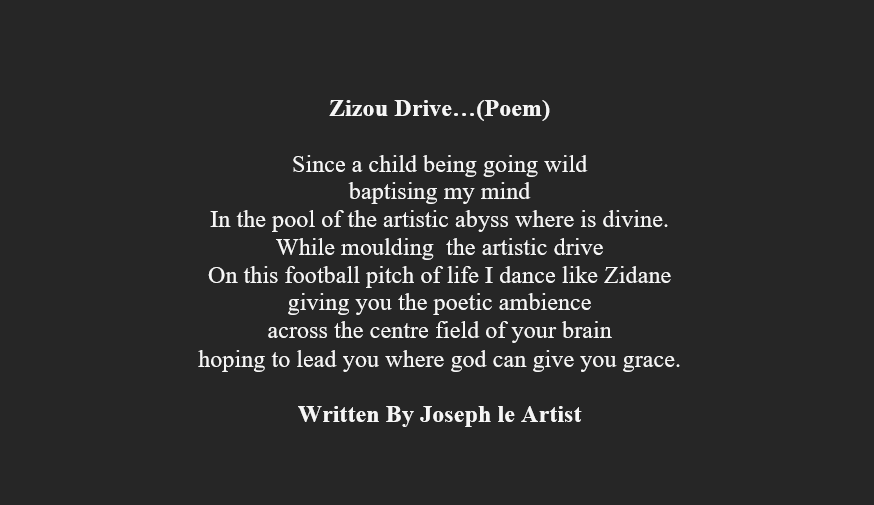
Dissected Threads
Tread One :Art as a Spiritual Journey: Poetry, Life, and the Quest for Grace…(Blog) .
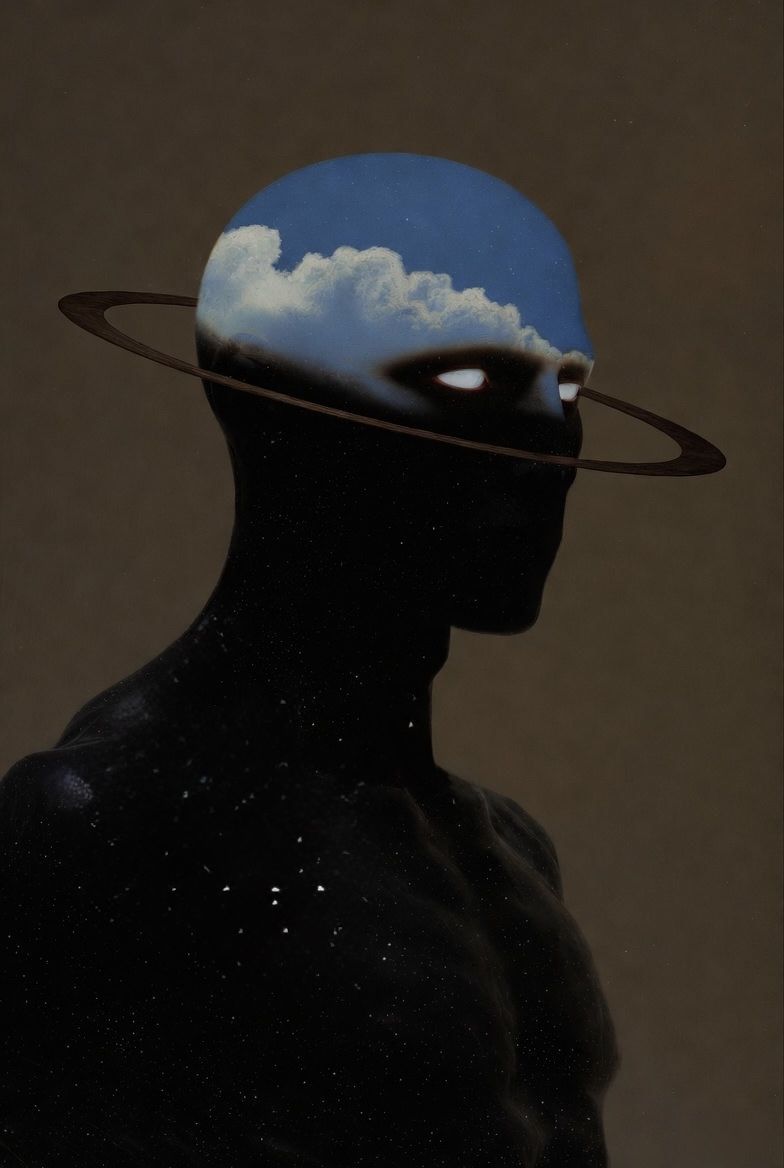
IntroIn a world that worships self-made strength and polished virtue, we quietly discover the painful truth that no man under the sun is heaven-sent—every heart is instead heaven-bent, twisted toward something greater yet stubbornly resistant to it. Our morality and values, so carefully constructed like Clark Kent’s mild-mannered disguise, prove anything but bulletproof; the first…

IntroAlex O’Connor Hypocrisy On Animal Suffering is a thought-provoking philosophical essay (likely from a debate or analysis channel) that challenges the common atheist argument against God’s existence based on animal suffering. It argues that such critiques can be hypocritical, as they often ignore humanity’s own massive role in causing and perpetuating animal pain through factory…
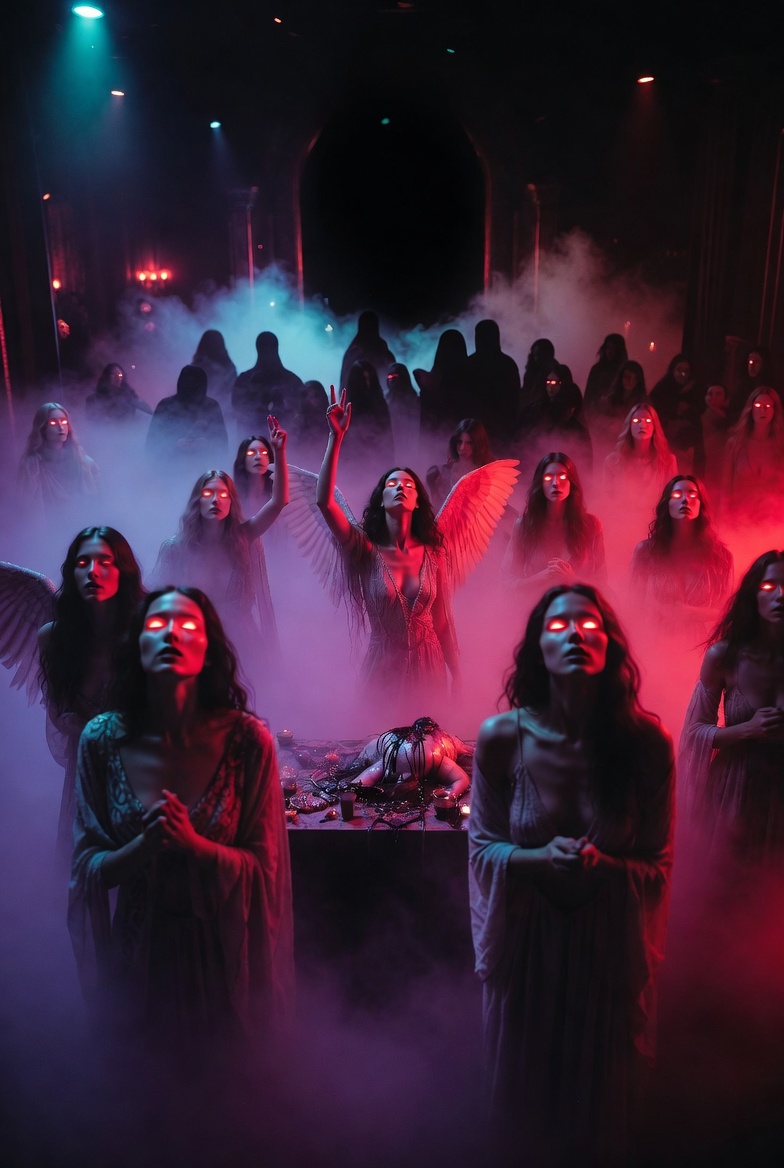
Intro Before I crossed the threshold into that pulsing underworld, I handed my soul to a fallen angel at the door—sealing a Faustian bargain for women who existed only in virtual promise, illusions spun from desire and digital haze. Inside, the club drowned in dark misty buzz, hypnotic music clamping my mind like a vice…

Intro In the shadowed attic of old grief, I found those frantic, handwritten letters—blasphemies scratched out by a younger me during a season of unrelenting calamity, heart emptied by pain and the lack of any real help. One page, opened on a whim, carried the desperate lie: “cursing God will fill your pocket with freedom…

Intro Sometimes I think about why the urge to create feels so natural, almost unavoidable, as if it was placed inside us long before we understood what art even was. It makes me wonder if creativity is part of the reason we exist at all—like God invented us so imagination could move through human hands…

Intro In an age where virtue is performed beneath studio lights and righteousness is rehearsed for applause, the loudest saviors often cast the longest shadows. History has shown how public personas can crumble — from the fall of R. Kelly to the scandal surrounding Jeffrey Epstein — revealing how influence and power can conceal disturbing…

IntroThis poem presents a sharp and cautionary portrait of a woman whose outer beauty conceals inner danger. By comparing her appearance to Stacy Dash, the speaker immediately establishes an image of striking physical attractiveness, only to contrast it with the darker image of a “fallen angel.” Throughout the poem, religious symbolism—halos, horns, heaven—blends with modern…

IntroPurpose and destiny have always guided me, embodied in figures like Tia and Tamara, whose presence kept me steady and focused on achieving higher victories. Their influence lit a path toward growth and fulfillment, shaping my choices and ambitions. Yet, life’s temptations came in the form of vices resembling Samara, pulling me toward darker paths…

IntroThrough powerful biblical symbolism and vivid, confrontational imagery, the poem examines the complex tension between femininity, masculinity, and authority. By invoking Moses parting the Red Sea as a metaphor for spiritual revelation and division, the speaker establishes a dramatic tone that carries throughout the piece. The contrasting portrayals of “quiet and feminine grace” against loud,…

IntroThrough powerful biblical symbolism and vivid, confrontational imagery, the poem examines the complex tension between femininity, masculinity, and authority. By invoking Moses parting the Red Sea as a metaphor for spiritual revelation and division, the speaker establishes a dramatic tone that carries throughout the piece. The contrasting portrayals of “quiet and feminine grace” against loud,…
Dissected Threads
Tread One :Art as a Spiritual Journey: Poetry, Life, and the Quest for Grace…(Blog) .
IntroIn a world that worships self-made strength and polished virtue, we quietly discover the painful truth that no man under the sun is heaven-sent—every heart is instead heaven-bent, twisted toward something greater yet stubbornly resistant to it. Our morality and values, so carefully constructed like Clark Kent’s mild-mannered disguise, prove anything but bulletproof; the first…
IntroAlex O’Connor Hypocrisy On Animal Suffering is a thought-provoking philosophical essay (likely from a debate or analysis channel) that challenges the common atheist argument against God’s existence based on animal suffering. It argues that such critiques can be hypocritical, as they often ignore humanity’s own massive role in causing and perpetuating animal pain through factory…
Intro Before I crossed the threshold into that pulsing underworld, I handed my soul to a fallen angel at the door—sealing a Faustian bargain for women who existed only in virtual promise, illusions spun from desire and digital haze. Inside, the club drowned in dark misty buzz, hypnotic music clamping my mind like a vice…
Intro In the shadowed attic of old grief, I found those frantic, handwritten letters—blasphemies scratched out by a younger me during a season of unrelenting calamity, heart emptied by pain and the lack of any real help. One page, opened on a whim, carried the desperate lie: “cursing God will fill your pocket with freedom…
Intro Sometimes I think about why the urge to create feels so natural, almost unavoidable, as if it was placed inside us long before we understood what art even was. It makes me wonder if creativity is part of the reason we exist at all—like God invented us so imagination could move through human hands…
Intro In an age where virtue is performed beneath studio lights and righteousness is rehearsed for applause, the loudest saviors often cast the longest shadows. History has shown how public personas can crumble — from the fall of R. Kelly to the scandal surrounding Jeffrey Epstein — revealing how influence and power can conceal disturbing…
IntroThis poem presents a sharp and cautionary portrait of a woman whose outer beauty conceals inner danger. By comparing her appearance to Stacy Dash, the speaker immediately establishes an image of striking physical attractiveness, only to contrast it with the darker image of a “fallen angel.” Throughout the poem, religious symbolism—halos, horns, heaven—blends with modern…
IntroPurpose and destiny have always guided me, embodied in figures like Tia and Tamara, whose presence kept me steady and focused on achieving higher victories. Their influence lit a path toward growth and fulfillment, shaping my choices and ambitions. Yet, life’s temptations came in the form of vices resembling Samara, pulling me toward darker paths…
IntroThrough powerful biblical symbolism and vivid, confrontational imagery, the poem examines the complex tension between femininity, masculinity, and authority. By invoking Moses parting the Red Sea as a metaphor for spiritual revelation and division, the speaker establishes a dramatic tone that carries throughout the piece. The contrasting portrayals of “quiet and feminine grace” against loud,…
IntroThrough powerful biblical symbolism and vivid, confrontational imagery, the poem examines the complex tension between femininity, masculinity, and authority. By invoking Moses parting the Red Sea as a metaphor for spiritual revelation and division, the speaker establishes a dramatic tone that carries throughout the piece. The contrasting portrayals of “quiet and feminine grace” against loud,…
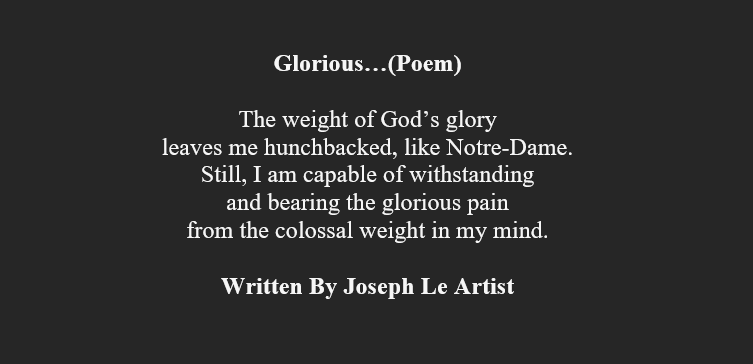
The poet’s words—“The weight of God’s glory / leaves me hunchbacked, like Notre-Dame. / Still, I am capable of withstanding / and bearing the glorious pain / from the colossal weight in my mind”—strike at the heart of a profound philosophical tension: the encounter between the finite human self and the infinite divine. This brief yet evocative verse serves as a lens through which to explore the existential and metaphysical implications of divine presence, the nature of human suffering, and the paradoxical strength found in submission to a transcendent burden.
The Weight of Transcendence
To speak of “God’s glory” is to invoke the sublime—a concept that philosophers like Immanuel Kant and Edmund Burke have described as an experience of awe mingled with terror, where the infinite overwhelms the finite. The poet’s imagery of being “hunchbacked, like Notre-Dame” captures this encounter vividly. Notre-Dame, whether understood as the cathedral or Victor Hugo’s Quasimodo, symbolizes endurance under immense pressure. The cathedral, a monument to divine aspiration, bears the scars of time—its gargoyles and spires weathered yet resolute. Quasimodo, deformed by his physical burden, embodies a soul capable of profound love and sacrifice. The poet’s “hunchbacked” posture is not merely physical but existential: the self, bent under the weight of divine encounter, is reshaped by the recognition of its own finitude against the infinite.
This weight is not merely oppressive but transformative. In the philosophy of Søren Kierkegaard, the encounter with the divine is a moment of “fear and trembling,” where the individual confronts the absurdity of faith—the paradox of embracing a truth that transcends reason. The “weight of God’s glory” can be seen as this Kierkegaardian leap, where the self is both shattered and reconstituted by its confrontation with the Absolute. To be hunchbacked is to bear the mark of this encounter, a visible sign of having wrestled with the divine, much like Jacob’s limp after his struggle with the angel.
The Glorious Pain
The poet’s assertion—“Still, I am capable of withstanding / and bearing the glorious pain”—introduces a dialectic of endurance and suffering. The phrase “glorious pain” is a profound oxymoron, echoing the Christian mystical tradition of figures like St. John of the Cross, who spoke of the “dark night of the soul” as a painful yet purifying path to divine union. Philosophically, this pain aligns with Martin Heidegger’s notion of Geworfenheit (thrownness), the human condition of being cast into existence without choice, burdened by the weight of Being itself. Yet, the poet’s claim of capability suggests an active response to this thrownness—a refusal to be crushed by the burden.
This resilience resonates with Friedrich Nietzsche’s concept of amor fati—the love of one’s fate. To bear the “glorious pain” is to embrace the suffering inherent in divine encounter, not as a passive victim but as a participant in a greater meaning. The glory lies not in the absence of pain but in its transformative potential, where suffering becomes a crucible for the self’s becoming. The poet’s endurance is not stoic detachment but a dynamic engagement with the divine, a willingness to carry the weight even as it bends the soul.
The Colossal Weight in the Mind
The final line—“from the colossal weight in my mind”—shifts the locus of this burden to the interiority of the self, inviting a phenomenological reflection on consciousness and its limits. The mind, as the seat of perception and understanding, becomes the arena where the divine is both apprehended and contested. This “colossal weight” evokes the overwhelming nature of divine truth, which resists containment within human categories. In the philosophy of Emmanuel Levinas, the encounter with the Other—whether human or divine—disrupts the self’s autonomy, imposing an ethical and existential weight that demands response. The “colossal weight in my mind” is thus the trace of the infinite within the finite, a presence that unsettles yet enriches the self’s understanding of itself and its place in the cosmos.
This interior burden also recalls Plato’s allegory of the cave, where the philosopher, having glimpsed the light of truth, returns to the cave burdened by knowledge that isolates and transforms. The “colossal weight” is the price of this vision—a cognitive and spiritual load that reshapes the self’s orientation toward reality. Yet, the poet’s declaration of capability suggests that this weight, though immense, is not paralyzing. It is a burden that the self can bear, not through its own strength alone but through a paradoxical participation in the divine glory that both wounds and sustains.
The Human Condition and Divine Encounter
The poem, in its brevity, encapsulates a universal human experience: the tension between finitude and infinity, suffering and transcendence. It challenges the modern inclination to seek comfort and certainty, proposing instead that true meaning lies in embracing the glorious pain of divine encounter. This is not a masochistic celebration of suffering but a recognition that the divine—whether understood as God, truth, or Being—demands a response that transforms the self. To be hunchbacked is to bear the mark of this transformation, a visible sign of having stood in the presence of the infinite.
In the end, the poet’s words invite us to reconsider our own burdens—spiritual, existential, or otherwise. What does it mean to carry the weight of glory? It is to live in the tension between awe and agony, to endure the bending of the self without breaking, to find strength in the very weight that humbles us. Like Notre-Dame, we may be weathered; like Quasimodo, we may be bent. But in bearing the colossal weight, we discover our capacity to withstand, to hold fast to the glorious pain, and to emerge not diminished but deepened by the encounter with the divine.
IntroIn a world that worships self-made strength and polished virtue, we quietly discover the painful truth that no man under the sun is heaven-sent—every heart is instead heaven-bent, twisted toward something greater yet stubbornly resistant to it. Our morality and values, so carefully constructed like Clark Kent’s mild-mannered disguise, prove anything but bulletproof; the first…
IntroAlex O’Connor Hypocrisy On Animal Suffering is a thought-provoking philosophical essay (likely from a debate or analysis channel) that challenges the common atheist argument against God’s existence based on animal suffering. It argues that such critiques can be hypocritical, as they often ignore humanity’s own massive role in causing and perpetuating animal pain through factory…
Intro Before I crossed the threshold into that pulsing underworld, I handed my soul to a fallen angel at the door—sealing a Faustian bargain for women who existed only in virtual promise, illusions spun from desire and digital haze. Inside, the club drowned in dark misty buzz, hypnotic music clamping my mind like a vice…
Intro In the shadowed attic of old grief, I found those frantic, handwritten letters—blasphemies scratched out by a younger me during a season of unrelenting calamity, heart emptied by pain and the lack of any real help. One page, opened on a whim, carried the desperate lie: “cursing God will fill your pocket with freedom…
Intro Sometimes I think about why the urge to create feels so natural, almost unavoidable, as if it was placed inside us long before we understood what art even was. It makes me wonder if creativity is part of the reason we exist at all—like God invented us so imagination could move through human hands…
Intro In an age where virtue is performed beneath studio lights and righteousness is rehearsed for applause, the loudest saviors often cast the longest shadows. History has shown how public personas can crumble — from the fall of R. Kelly to the scandal surrounding Jeffrey Epstein — revealing how influence and power can conceal disturbing…
IntroThis poem presents a sharp and cautionary portrait of a woman whose outer beauty conceals inner danger. By comparing her appearance to Stacy Dash, the speaker immediately establishes an image of striking physical attractiveness, only to contrast it with the darker image of a “fallen angel.” Throughout the poem, religious symbolism—halos, horns, heaven—blends with modern…
IntroPurpose and destiny have always guided me, embodied in figures like Tia and Tamara, whose presence kept me steady and focused on achieving higher victories. Their influence lit a path toward growth and fulfillment, shaping my choices and ambitions. Yet, life’s temptations came in the form of vices resembling Samara, pulling me toward darker paths…
IntroThrough powerful biblical symbolism and vivid, confrontational imagery, the poem examines the complex tension between femininity, masculinity, and authority. By invoking Moses parting the Red Sea as a metaphor for spiritual revelation and division, the speaker establishes a dramatic tone that carries throughout the piece. The contrasting portrayals of “quiet and feminine grace” against loud,…
IntroThrough powerful biblical symbolism and vivid, confrontational imagery, the poem examines the complex tension between femininity, masculinity, and authority. By invoking Moses parting the Red Sea as a metaphor for spiritual revelation and division, the speaker establishes a dramatic tone that carries throughout the piece. The contrasting portrayals of “quiet and feminine grace” against loud,…
Dissected Threads
Tread One : The Weight of Divine Glory: A Philosophical Reflection on Spiritual Burden.
IntroIn a world that worships self-made strength and polished virtue, we quietly discover the painful truth that no man under the sun is heaven-sent—every heart is instead heaven-bent, twisted toward something greater yet stubbornly resistant to it. Our morality and values, so carefully constructed like Clark Kent’s mild-mannered disguise, prove anything but bulletproof; the first…
IntroAlex O’Connor Hypocrisy On Animal Suffering is a thought-provoking philosophical essay (likely from a debate or analysis channel) that challenges the common atheist argument against God’s existence based on animal suffering. It argues that such critiques can be hypocritical, as they often ignore humanity’s own massive role in causing and perpetuating animal pain through factory…
Intro Before I crossed the threshold into that pulsing underworld, I handed my soul to a fallen angel at the door—sealing a Faustian bargain for women who existed only in virtual promise, illusions spun from desire and digital haze. Inside, the club drowned in dark misty buzz, hypnotic music clamping my mind like a vice…
Intro In the shadowed attic of old grief, I found those frantic, handwritten letters—blasphemies scratched out by a younger me during a season of unrelenting calamity, heart emptied by pain and the lack of any real help. One page, opened on a whim, carried the desperate lie: “cursing God will fill your pocket with freedom…
Intro Sometimes I think about why the urge to create feels so natural, almost unavoidable, as if it was placed inside us long before we understood what art even was. It makes me wonder if creativity is part of the reason we exist at all—like God invented us so imagination could move through human hands…
Intro In an age where virtue is performed beneath studio lights and righteousness is rehearsed for applause, the loudest saviors often cast the longest shadows. History has shown how public personas can crumble — from the fall of R. Kelly to the scandal surrounding Jeffrey Epstein — revealing how influence and power can conceal disturbing…
IntroThis poem presents a sharp and cautionary portrait of a woman whose outer beauty conceals inner danger. By comparing her appearance to Stacy Dash, the speaker immediately establishes an image of striking physical attractiveness, only to contrast it with the darker image of a “fallen angel.” Throughout the poem, religious symbolism—halos, horns, heaven—blends with modern…
IntroPurpose and destiny have always guided me, embodied in figures like Tia and Tamara, whose presence kept me steady and focused on achieving higher victories. Their influence lit a path toward growth and fulfillment, shaping my choices and ambitions. Yet, life’s temptations came in the form of vices resembling Samara, pulling me toward darker paths…
IntroThrough powerful biblical symbolism and vivid, confrontational imagery, the poem examines the complex tension between femininity, masculinity, and authority. By invoking Moses parting the Red Sea as a metaphor for spiritual revelation and division, the speaker establishes a dramatic tone that carries throughout the piece. The contrasting portrayals of “quiet and feminine grace” against loud,…
IntroThrough powerful biblical symbolism and vivid, confrontational imagery, the poem examines the complex tension between femininity, masculinity, and authority. By invoking Moses parting the Red Sea as a metaphor for spiritual revelation and division, the speaker establishes a dramatic tone that carries throughout the piece. The contrasting portrayals of “quiet and feminine grace” against loud,…
The poem “Flannel and Cherubim Fabrics” resonates deeply with me, weaving a philosophical reflection on my struggle to define my authentic self against the soft, suffocating threads of cultural expectation. I feel culture stitching my soul with “soft and fuzzy fabrics” of flannel—warm, feminine, cozy—yet these threads leave my heart anxious, my true essence buried beneath their weight. This imagery mirrors Jean-Paul Sartre’s existentialist warnings about society’s power to drown my authenticity in conformity. The flannel’s comforting, patterned texture feels like Nietzsche’s herd morality, lulling me into a passive acceptance that stifles my individuality. My spirit, confined by these cultural patterns, aches for liberation, yearning to break free and express who I truly am.
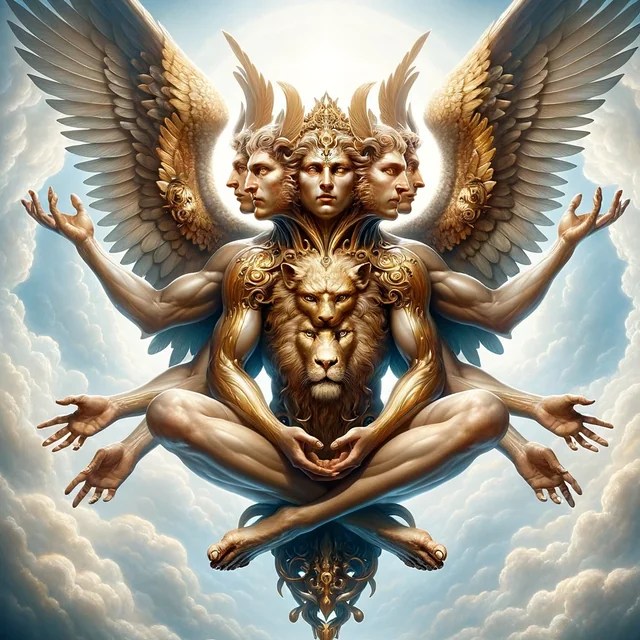
In a moment of defiance, I snatch the sewing fabric from culture’s hands, reclaiming my agency in a way that echoes existentialist ideas of radical freedom. I refuse to be boxed by flannel’s cozy constraints, choosing instead to hand the fabric to cherubim—divine beings of wisdom and strength. In Christian tradition, cherubim bear the faces of eagle, lion, bull, and human, symbolizing vision, courage, resilience, and insight. By entrusting my soul to their hands, I seek a transformation beyond the reach of human culture, one guided by a higher, divine truth. This act reflects my longing to escape societal norms and discover a self that aligns with my deepest, most authentic desires.
The poem’s transformation unfolds as I cast off the “feminine and warm” identity culture imposed on me, embracing a “masculine and peculiar” self woven with “eagle, lion, and bull characteristic strands.” This shift feels like Carl Jung’s individuation, where I integrate powerful archetypes to become whole. The “masculine” isn’t about gender but about strength and assertiveness, while “peculiar” marks me as unique, akin to Kierkegaard’s knight of faith, standing apart through my connection to the divine. My new countenance—bold, visionary, steadfast—rejects flannel’s passive softness, embodying a dynamic, self-authored identity that stands firm against cultural pressures.
The metaphor of sewing runs through my reflection, symbolizing how my identity is crafted. Flannel, with its cozy yet limiting texture, represents the seductive comfort of fitting in, but it chokes my spirit. In contrast, the cherubim’s strands weave a vibrant, multifaceted self, echoing Plato’s view of the soul as a composite shaped by the forces I allow to guide it. When I give “free will” to the cherubim, I surrender to a divine creative power, trusting it to stitch a truer version of me. This surrender carries the mystical weight of Meister Eckhart’s teachings, where my soul seeks its divine source. My transformation feels like providence, a purposeful guidance reshaping my inner and outer self.
Ultimately, “Flannel and Cherubim Fabrics” challenges me to reject the “softness” and “cosy flannel texture” of culture, which Stoic philosophers like Marcus Aurelius might call a trap of complacency. By becoming a “masculine and peculiar man,” I embrace resilience and self-mastery, capable of withstanding societal norms. The poem weaves existentialist, Jungian, Stoic, and mystical insights, urging me to seize control of my soul’s fabric and trust a higher power to craft an authentic self. My journey is one of courage and transcendence, stitching an identity that’s uniquely mine—strong, visionary, and unyielding against culture’s comforting but confining patterns.
IntroIn a world that worships self-made strength and polished virtue, we quietly discover the painful truth that no man under the sun is heaven-sent—every heart is instead heaven-bent, twisted toward something greater yet stubbornly resistant to it. Our morality and values, so carefully constructed like Clark Kent’s mild-mannered disguise, prove anything but bulletproof; the first…
IntroAlex O’Connor Hypocrisy On Animal Suffering is a thought-provoking philosophical essay (likely from a debate or analysis channel) that challenges the common atheist argument against God’s existence based on animal suffering. It argues that such critiques can be hypocritical, as they often ignore humanity’s own massive role in causing and perpetuating animal pain through factory…
Intro Before I crossed the threshold into that pulsing underworld, I handed my soul to a fallen angel at the door—sealing a Faustian bargain for women who existed only in virtual promise, illusions spun from desire and digital haze. Inside, the club drowned in dark misty buzz, hypnotic music clamping my mind like a vice…
Intro In the shadowed attic of old grief, I found those frantic, handwritten letters—blasphemies scratched out by a younger me during a season of unrelenting calamity, heart emptied by pain and the lack of any real help. One page, opened on a whim, carried the desperate lie: “cursing God will fill your pocket with freedom…
Intro Sometimes I think about why the urge to create feels so natural, almost unavoidable, as if it was placed inside us long before we understood what art even was. It makes me wonder if creativity is part of the reason we exist at all—like God invented us so imagination could move through human hands…
Intro In an age where virtue is performed beneath studio lights and righteousness is rehearsed for applause, the loudest saviors often cast the longest shadows. History has shown how public personas can crumble — from the fall of R. Kelly to the scandal surrounding Jeffrey Epstein — revealing how influence and power can conceal disturbing…
IntroThis poem presents a sharp and cautionary portrait of a woman whose outer beauty conceals inner danger. By comparing her appearance to Stacy Dash, the speaker immediately establishes an image of striking physical attractiveness, only to contrast it with the darker image of a “fallen angel.” Throughout the poem, religious symbolism—halos, horns, heaven—blends with modern…
IntroPurpose and destiny have always guided me, embodied in figures like Tia and Tamara, whose presence kept me steady and focused on achieving higher victories. Their influence lit a path toward growth and fulfillment, shaping my choices and ambitions. Yet, life’s temptations came in the form of vices resembling Samara, pulling me toward darker paths…
IntroThrough powerful biblical symbolism and vivid, confrontational imagery, the poem examines the complex tension between femininity, masculinity, and authority. By invoking Moses parting the Red Sea as a metaphor for spiritual revelation and division, the speaker establishes a dramatic tone that carries throughout the piece. The contrasting portrayals of “quiet and feminine grace” against loud,…
IntroThrough powerful biblical symbolism and vivid, confrontational imagery, the poem examines the complex tension between femininity, masculinity, and authority. By invoking Moses parting the Red Sea as a metaphor for spiritual revelation and division, the speaker establishes a dramatic tone that carries throughout the piece. The contrasting portrayals of “quiet and feminine grace” against loud,…

Dissected Threads
Tread One :
Unveiling Authenticity: A Philosophical Analysis of ‘Flannel and Cherubim Fabrics’
 LifeandTimelessart