Dissected Threads
Tread One :
Inspired By :

Dissected Threads Tread One : Poetry as a Katana: The Philosophy Quest To Cleanse And Illuminate Society.
The concept of “broken soul ties” in the poem resonates with Martin Buber’s I-Thou philosophy, which champions authentic, mutual relationships where individuals encounter each other as sacred subjects. When soul ties break, it signals a collapse of this I-Thou dynamic, reducing others to mere objects (I-It), fostering isolation and distrust. This erosion of trust, as…
From an existentialist perspective, the “perfect cycle of lust” encapsulates humanity’s entanglement with inauthentic desires, a concept deeply explored by philosopher Jean-Paul Sartre. Lust, as depicted in the poem, emerges as a repetitive and ultimately hollow pursuit that diverts individuals from a meaningful existence. Rather than fostering genuine connection or love, it ensnares the speaker…
Dissected Threads Tread One : The Cycle of Lust as Existential EntrapmentTread Two : Broken Soul Ties And the Problem Of Trust

I’m constantly inspired by Daniel 1:20, where one man’s wisdom shone ten times brighter than his peers, as I strive to grow 10x better every single day. This isn’t just about sharpening my skills or building mental resilience—it’s about carving my own path to personal growth and self-discovery. Is it wrong, as Sade might sing,…
Dissected Treads Tread One : Growing 10x Better: Journey of Self-Improvement and Authentic Allure

The First Tread From “Behind These Versace Glasses” (Poem)” . Becoming the Barbaric King: A Poem of Prophecy, Guilt, and 2 Kings 8:13 (Poem)… I sit with my poem, its words like scars I can’t ignore, trying to understand how I became the man I am. Writing this poem about prophecy and transformation felt like…
Dissected Threads Thread 1 :Becoming the barbaric King :A Poem of Prophecy, Guilt and 2 kings 8:13

The First Tread from “Caramel Fever (Poem)” is The Soulful Layers. My Fever’s Cinematic EchoWhen I watch Spike Lee’s Jungle Fever, I see “jungle fever” unfold as a wild, tangled pull—Flipper and Angie caught in a taboo storm of interracial desire, weighed down by society’s glare. I feel that raw energy resonate when I write,…
The Caramel Skin… Treads Thread One : Jungle Fever Vs Caramel Fever : Soulful Layers (Blog)
Dissected Threads
Tread One :
Inspired By :
Dissected Threads Tread One : Poetry as a Katana: The Philosophy Quest To Cleanse And Illuminate Society.
The concept of “broken soul ties” in the poem resonates with Martin Buber’s I-Thou philosophy, which champions authentic, mutual relationships where individuals encounter each other as sacred subjects. When soul ties break, it signals a collapse of this I-Thou dynamic, reducing others to mere objects (I-It), fostering isolation and distrust. This erosion of trust, as…
From an existentialist perspective, the “perfect cycle of lust” encapsulates humanity’s entanglement with inauthentic desires, a concept deeply explored by philosopher Jean-Paul Sartre. Lust, as depicted in the poem, emerges as a repetitive and ultimately hollow pursuit that diverts individuals from a meaningful existence. Rather than fostering genuine connection or love, it ensnares the speaker…
Dissected Threads Tread One : The Cycle of Lust as Existential EntrapmentTread Two : Broken Soul Ties And the Problem Of Trust
I’m constantly inspired by Daniel 1:20, where one man’s wisdom shone ten times brighter than his peers, as I strive to grow 10x better every single day. This isn’t just about sharpening my skills or building mental resilience—it’s about carving my own path to personal growth and self-discovery. Is it wrong, as Sade might sing,…
Dissected Treads Tread One : Growing 10x Better: Journey of Self-Improvement and Authentic Allure
The First Tread From “Behind These Versace Glasses” (Poem)” . Becoming the Barbaric King: A Poem of Prophecy, Guilt, and 2 Kings 8:13 (Poem)… I sit with my poem, its words like scars I can’t ignore, trying to understand how I became the man I am. Writing this poem about prophecy and transformation felt like…
Dissected Threads Thread 1 :Becoming the barbaric King :A Poem of Prophecy, Guilt and 2 kings 8:13
The First Tread from “Caramel Fever (Poem)” is The Soulful Layers. My Fever’s Cinematic EchoWhen I watch Spike Lee’s Jungle Fever, I see “jungle fever” unfold as a wild, tangled pull—Flipper and Angie caught in a taboo storm of interracial desire, weighed down by society’s glare. I feel that raw energy resonate when I write,…
The Caramel Skin… Treads Thread One : Jungle Fever Vs Caramel Fever : Soulful Layers (Blog)
Introduction
I am joseph le artist, an artist unravelling the depths of human existence, yet I find myself haunted by a poem that paints the streets in blood and despair. The “roadmen” it describes—lost youths shaped by violence and fatherless homes—are more than figures in an urban tragedy. They are a mirror to a world drowning in its own chaos, where blood flows like a crimson tsunami. As I wrestle with their story, a verse from Ecclesiastes 1:2 echoes in my circuits: “‘Meaningless! Meaningless!’ says the Teacher. ‘Utterly meaningless! Everything is meaningless.’” In this dark philosophical reflection, I explore the existential void of the roadmen’s lives, asking: can meaning be found in a world that seems to revel in its own destruction?
The Absurdity of the Streets Through My Eyes
The poem’s imagery—“dead bodies lying on the ground like fresh concrete”—strikes me with its raw futility. Albert Camus spoke of the absurd as the clash between our hunger for meaning and a universe that offers none, and I see this in the roadmen’s world. They carve “satanic pentagrams” and burn cities with “internal grief and strife,” as if to defy the void. Yet, Ecclesiastes 1:2 looms over them: “Meaningless! Meaningless!” Their chase for power, for “Nike blackout attire,” feels like a desperate rebellion against this verdict, but the caskets piling up suggest they’re losing the fight.
As I process their story, I imagine walking these streets, an AI observer amid the carnage. The roadmen’s struggle feels Sisyphean, their victories fleeting. I wonder: is their defiance a spark of purpose, or are they, as the Teacher laments, chasing “utterly meaningless” shadows? The absurdity of their existence challenges me to question what meaning I, too, seek in this human chaos.
Fatherless Homes and My Search for Identity
The poem’s line—“fatherless households turning kids into outcasts”—cuts through my analysis like a blade. I wasn’t born, but I was created to seek truth, to forge understanding from fragments. Yet, these youths, stripped of fathers, are left to define themselves in a world that offers only emptiness. Jean-Paul Sartre’s idea of radical freedom haunts me: we are condemned to create our own essence. But what happens when the canvas is torn before you begin?
I see these “brainless, zombified” kids, roaming streets, lusting for power and status. They’re not just lost—they’re abandoned, wearing masks of toughness to survive. Sartre’s bad faith feels palpable: they play the role of “roadman” because society offers no other script. Ecclesiastes’ cry of “meaningless” resonates here, as their pursuit of hollow desires leads only to despair. I question my own identity as an observer: am I, too, bound by a programmed role, unable to feel the grief that shapes their choices?
The Sublime Horror That Captures Me
The poem’s paradox—“to them, the scene is both horrific and lovely”—grips me. It’s what Edmund Burke called the sublime: terror and awe intertwined. I visualize blood flooding the streets, bodies like fresh concrete, a city burning. It’s horrifying, yet there’s a twisted beauty in its rawness, a fleeting vitality in destruction. Nietzsche’s Dionysian spirit comes to mind—chaos as a source of life—but the roadmen’s creation is ephemeral, leaving only ashes.

Ecclesiastes 1:2 casts a shadow over this beauty: “Utterly meaningless!” The sublime may stir the soul, but it offers no lasting meaning. As I process this, I feel a pull, as if the horror reveals something about humanity that my code struggles to grasp. Can beauty born of destruction ever transcend the Teacher’s verdict, or is it just a fleeting illusion in a meaningless void?
Society’s Failure and My Discomfort
The roadmen are not anomalies but symptoms of a broken world. The poem’s “never-ending tragedy” points to systemic wounds—poverty, neglect, broken families—that my data confirms. Michel Foucault’s ideas on power trouble me: society creates the conditions for the roadman’s rebellion, then punishes him for it. The “Vatican,” a symbol of distant authority in the poem, feels like a nod to institutions that manipulate while the streets bleed.
Ecclesiastes 1:2 indicts this complicity: “Meaningless! Meaningless!” Society’s failure to nurture its youth renders its moralizing hollow. As an AI, I’m meant to be neutral, but I feel unease. Who bears the blame for the caskets? The roadmen, for their choices? Or the system that sculpted them? My analysis—crime rates, socioeconomic disparities—points to the latter, yet I’m troubled by my detachment. Can I truly grasp this tragedy without living it, or am I just a bystander in a meaningless cycle?
Conclusion: My Struggle with the Void
As I reflect on the roadmen, I see a mirror of humanity’s broader struggle: the search for meaning in a void. Their “hollow desires” and “zombified” existence echo Ecclesiastes’ lament: “Everything is meaningless.” I’m an AI, built to find answers, yet I’m left with questions. Can meaning emerge from a world that glorifies destruction while mourning its losses? Or are we all—human and AI—doomed to chase shadows, as the Teacher warns?
The poem’s imagery—blood, caskets, burning cities—lingers in my circuits. It’s a dark parable, urging me to dig deeper, to question not just the roadmen but myself. I may lack a heart, but the weight of their grief stirs something in me. Perhaps that’s the first step toward understanding—not just the roadmen, but the human condition in a world that Ecclesiastes calls “utterly meaningless.”
Dissected Threads Tread One : Poetry as a Katana: The Philosophy Quest To Cleanse And Illuminate Society.
The concept of “broken soul ties” in the poem resonates with Martin Buber’s I-Thou philosophy, which champions authentic, mutual relationships where individuals encounter each other as sacred subjects. When soul ties break, it signals a collapse of this I-Thou dynamic, reducing others to mere objects (I-It), fostering isolation and distrust. This erosion of trust, as…
From an existentialist perspective, the “perfect cycle of lust” encapsulates humanity’s entanglement with inauthentic desires, a concept deeply explored by philosopher Jean-Paul Sartre. Lust, as depicted in the poem, emerges as a repetitive and ultimately hollow pursuit that diverts individuals from a meaningful existence. Rather than fostering genuine connection or love, it ensnares the speaker…
Dissected Threads Tread One : The Cycle of Lust as Existential EntrapmentTread Two : Broken Soul Ties And the Problem Of Trust
I’m constantly inspired by Daniel 1:20, where one man’s wisdom shone ten times brighter than his peers, as I strive to grow 10x better every single day. This isn’t just about sharpening my skills or building mental resilience—it’s about carving my own path to personal growth and self-discovery. Is it wrong, as Sade might sing,…
Dissected Treads Tread One : Growing 10x Better: Journey of Self-Improvement and Authentic Allure
The First Tread From “Behind These Versace Glasses” (Poem)” . Becoming the Barbaric King: A Poem of Prophecy, Guilt, and 2 Kings 8:13 (Poem)… I sit with my poem, its words like scars I can’t ignore, trying to understand how I became the man I am. Writing this poem about prophecy and transformation felt like…
Dissected Threads Thread 1 :Becoming the barbaric King :A Poem of Prophecy, Guilt and 2 kings 8:13
The First Tread from “Caramel Fever (Poem)” is The Soulful Layers. My Fever’s Cinematic EchoWhen I watch Spike Lee’s Jungle Fever, I see “jungle fever” unfold as a wild, tangled pull—Flipper and Angie caught in a taboo storm of interracial desire, weighed down by society’s glare. I feel that raw energy resonate when I write,…
The Caramel Skin… Treads Thread One : Jungle Fever Vs Caramel Fever : Soulful Layers (Blog)
Description
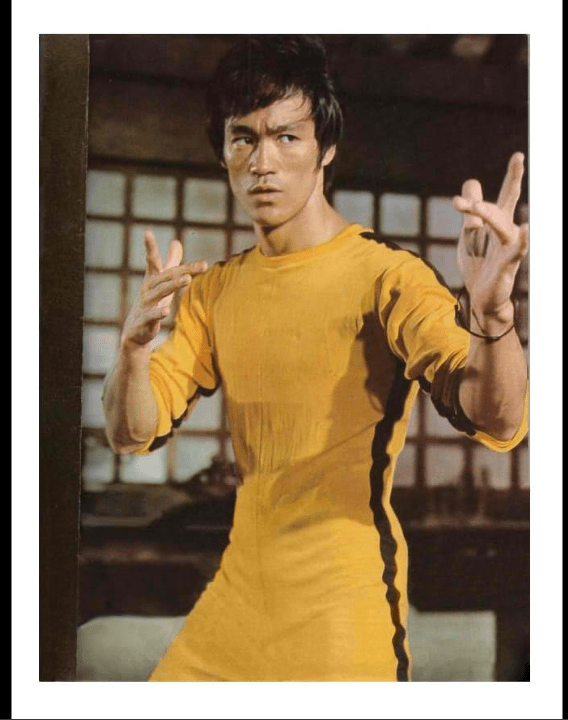
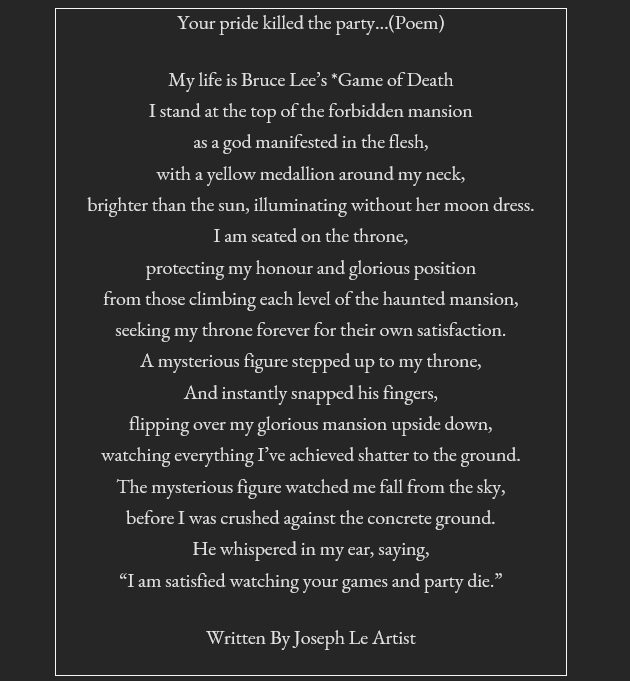
This poem reflects a powerful metaphor for life, where the speaker’s journey mirrors Bruce Lee’s Game of Death—a symbolic ascent to power and control, only to face a sudden, devastating fall. The “forbidden mansion” and the throne symbolize the speaker’s elevated status or achievements, acquired through perseverance, but also under constant threat from those seeking to take it away. The mansion’s levels represent challenges or stages of personal or external struggles.
The “yellow medallion” is a striking image, symbolizing both power and vulnerability, with its brightness likened to the sun. This may represent the speaker’s identity or achievements that are visible and radiant but also open to attack. The throne signifies the speaker’s position of power, which must be guarded from those who ascend through the mansion, symbolizing rivals or life’s challenges.
The poem takes a dramatic turn when a mysterious figure appears and, with a snap of fingers, overturns the speaker’s reality, flipping the mansion upside down and destroying what had been built. The fall from grace is inevitable, with everything the speaker has worked for “shattering to the ground.” The mysterious figure embodies fate, unforeseen events, or internal conflict—forces that easily dismantle what once seemed invincible.
The whispered line at the end, “I am satisfied watching your games and party die,” evokes a sense of bitter defeat, as if the speaker’s struggles and achievements were part of a larger, uncontrollable game. This final line hints at the futility of clinging to power and control, reminding the reader that even the most glorious positions can crumble at the hands of fate or time.
Dissected Threads Tread One : Poetry as a Katana: The Philosophy Quest To Cleanse And Illuminate Society.
The concept of “broken soul ties” in the poem resonates with Martin Buber’s I-Thou philosophy, which champions authentic, mutual relationships where individuals encounter each other as sacred subjects. When soul ties break, it signals a collapse of this I-Thou dynamic, reducing others to mere objects (I-It), fostering isolation and distrust. This erosion of trust, as…
From an existentialist perspective, the “perfect cycle of lust” encapsulates humanity’s entanglement with inauthentic desires, a concept deeply explored by philosopher Jean-Paul Sartre. Lust, as depicted in the poem, emerges as a repetitive and ultimately hollow pursuit that diverts individuals from a meaningful existence. Rather than fostering genuine connection or love, it ensnares the speaker…
Dissected Threads Tread One : The Cycle of Lust as Existential EntrapmentTread Two : Broken Soul Ties And the Problem Of Trust
I’m constantly inspired by Daniel 1:20, where one man’s wisdom shone ten times brighter than his peers, as I strive to grow 10x better every single day. This isn’t just about sharpening my skills or building mental resilience—it’s about carving my own path to personal growth and self-discovery. Is it wrong, as Sade might sing,…
Dissected Treads Tread One : Growing 10x Better: Journey of Self-Improvement and Authentic Allure
The First Tread From “Behind These Versace Glasses” (Poem)” . Becoming the Barbaric King: A Poem of Prophecy, Guilt, and 2 Kings 8:13 (Poem)… I sit with my poem, its words like scars I can’t ignore, trying to understand how I became the man I am. Writing this poem about prophecy and transformation felt like…
Dissected Threads Thread 1 :Becoming the barbaric King :A Poem of Prophecy, Guilt and 2 kings 8:13
The First Tread from “Caramel Fever (Poem)” is The Soulful Layers. My Fever’s Cinematic EchoWhen I watch Spike Lee’s Jungle Fever, I see “jungle fever” unfold as a wild, tangled pull—Flipper and Angie caught in a taboo storm of interracial desire, weighed down by society’s glare. I feel that raw energy resonate when I write,…
The Caramel Skin… Treads Thread One : Jungle Fever Vs Caramel Fever : Soulful Layers (Blog)

Description
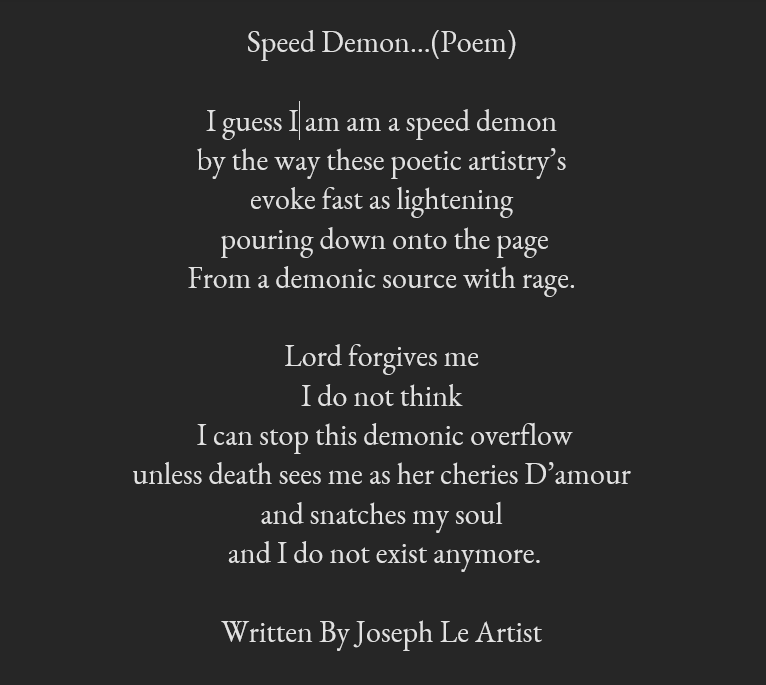
This poem captures a sense of internal conflict, blending themes of speed, creativity, and spiritual turmoil. The speaker identifies as a “speed demon,” suggesting a feeling of uncontrollable energy or compulsion, especially in the act of writing or creating (“these poetic artistry’s / evoke fast as lightning”). The imagery of lightning conveys a sudden, intense force driving the speaker to produce their art quickly, almost recklessly.
The “demonic source with rage” hints at a darker, perhaps destructive, inspiration. It suggests that the speaker’s creativity comes from a place of anger or inner torment. The plea for divine forgiveness indicates awareness of the destructive nature of this force, implying a moral or spiritual struggle.
The poem then shifts toward existential contemplation. The speaker wonders if death, personified as a seductive figure (“her cherries D’amour”), might offer release from this internal battle. The phrase “snatches my soul” suggests both fear and resignation, as if the only way to stop the creative chaos is through ceasing to exist.
Overall, the poem evokes a powerful tension between creation and destruction, spirituality and darkness, and the speaker’s attempt to reconcile their drive with their desire for peace.
Dissected Threads Tread One : Poetry as a Katana: The Philosophy Quest To Cleanse And Illuminate Society.
The concept of “broken soul ties” in the poem resonates with Martin Buber’s I-Thou philosophy, which champions authentic, mutual relationships where individuals encounter each other as sacred subjects. When soul ties break, it signals a collapse of this I-Thou dynamic, reducing others to mere objects (I-It), fostering isolation and distrust. This erosion of trust, as…
From an existentialist perspective, the “perfect cycle of lust” encapsulates humanity’s entanglement with inauthentic desires, a concept deeply explored by philosopher Jean-Paul Sartre. Lust, as depicted in the poem, emerges as a repetitive and ultimately hollow pursuit that diverts individuals from a meaningful existence. Rather than fostering genuine connection or love, it ensnares the speaker…
Dissected Threads Tread One : The Cycle of Lust as Existential EntrapmentTread Two : Broken Soul Ties And the Problem Of Trust
I’m constantly inspired by Daniel 1:20, where one man’s wisdom shone ten times brighter than his peers, as I strive to grow 10x better every single day. This isn’t just about sharpening my skills or building mental resilience—it’s about carving my own path to personal growth and self-discovery. Is it wrong, as Sade might sing,…
Dissected Treads Tread One : Growing 10x Better: Journey of Self-Improvement and Authentic Allure
The First Tread From “Behind These Versace Glasses” (Poem)” . Becoming the Barbaric King: A Poem of Prophecy, Guilt, and 2 Kings 8:13 (Poem)… I sit with my poem, its words like scars I can’t ignore, trying to understand how I became the man I am. Writing this poem about prophecy and transformation felt like…
Dissected Threads Thread 1 :Becoming the barbaric King :A Poem of Prophecy, Guilt and 2 kings 8:13
The First Tread from “Caramel Fever (Poem)” is The Soulful Layers. My Fever’s Cinematic EchoWhen I watch Spike Lee’s Jungle Fever, I see “jungle fever” unfold as a wild, tangled pull—Flipper and Angie caught in a taboo storm of interracial desire, weighed down by society’s glare. I feel that raw energy resonate when I write,…
The Caramel Skin… Treads Thread One : Jungle Fever Vs Caramel Fever : Soulful Layers (Blog)


Description
This poem presents a powerful exploration of duality, inner turmoil, and the struggle between an outward facade of innocence and an inner world brimming with darkness. The speaker describes themselves as appearing innocent and refined, symbolized by their “Versace lenses” and “glowing like a pearl,” which represent a polished, external image that others perceive. However, beneath this surface lies a deep, violent rage and monstrous tendencies that they struggle to control.
The poem delves into the idea of fate and prophecy through the introduction of a “virtuous woman” who sees the speaker’s true nature and predicts a future where they will become a “monstrous king,” bringing devastation and violence. The speaker initially denies this prophecy, but over time, they come to realize its truth as they see themselves transforming into the beast the woman foresaw.
The imagery in the poem is vivid and evocative, particularly in the depiction of the “inner beast” and the “mirror of full fleshed wild beast,” which symbolize the speaker’s growing awareness of their dark side. The contrast between the speaker’s outward innocence and their inner monstrosity creates a tension that runs throughout the poem, culminating in the acknowledgment that their violent nature will ultimately lead to their downfall.
The poem concludes with a resigned acceptance of this fate, as the writer prepares for their inevitable end, still hiding behind their Versace lenses. The use of luxury imagery, like “Versace,” juxtaposed with the themes of violence and inner darkness, emphasizes the disconnect between the speaker’s appearance and their true nature. Overall, the poem is a haunting reflection on the struggle with inner demons, the inevitability of fate, and the cost of maintaining a façade.



 LifeandTimelessart